Kamakura in November: Where and When to See Autumn Leaves
Kamakura's autumn leaves turn later than most of Japan, usually peaking from late November to early December. Here is where to go, the 2026 light-up dates, and how to get there from Tokyo.
Kamakura in November is one of the easiest ways to see Japan's autumn leaves without leaving the Tokyo area. The town sits about an hour south of Tokyo Station by train, its temples are tucked into wooded valleys full of maples and ginkgo trees, and the color arrives later here than in most of Japan. That last point matters for planning. If you come in early November, you may find mostly green trees. Come in the last week of the month, and the temple gardens are usually at their best.
This guide covers when the leaves usually turn, which temples and shrines to visit, the 2026 evening light-up dates, the current train fare from Tokyo, and a simple one-day route. If you are new to the town, our guide to things to do in Kamakura gives a wider overview, and our Kamakura and Enoshima day trip guide adds the island down the coast.
Is Kamakura in November good for autumn leaves?
Yes, as long as you aim for the second half of the month. According to the Kamakura City Tourist Association, autumn color in Kamakura comes later than in other areas. The trees start to turn in November, beginning around Kita-Kamakura Station, and the town as a whole usually reaches its best from late November to early December. The city's own seasonal guide gives a slightly wider window of late November to mid December.
So the short answer looks like this:
Early November: a few early trees and some yellow ginkgo, but most maples are still green.
Mid November: color builds in the northern valleys around Kita-Kamakura.
Late November: the usual start of peak season across most of the town.
Early December: still prime time, especially around Kamakura Station and the temples to the east.
Mid December: a handful of later spots, such as Kakuon-ji, can still be at their best.
In 2025, the tourist association's reports had Kencho-ji at its best on November 28 and Hokoku-ji and the rear garden of Meigetsu-in on December 2, while Myohon-ji, one of the latest temples in town, still had peak color on December 25.
Exact timing moves from year to year. A warm autumn pushes the peak later, and a cool one brings it forward. In 2024, for example, the tourist association reported that a long, hot summer delayed the season. Before you lock in a date, look at the tourist association's color reports on its official site, which it updates through the season.
What about Kamakura in December?
If your trip falls in the first week or two of December, you have not missed it. Kamakura is one of the few places near Tokyo where early December is often better than mid November. The light-up at Hase-dera runs until December 6 in 2026, and the special autumn opening at Kakuon-ji continues until December 10.
Where to see autumn leaves in Kamakura
Kamakura's best autumn color is spread across several small areas. You will not see them all in one day, so pick two or three that match your dates.
Kita-Kamakura: Engaku-ji, Kencho-ji and Meigetsu-in
Kita-Kamakura is where the color usually starts, and it is the stop before Kamakura on the JR Yokosuka Line, so it makes an easy first stop.
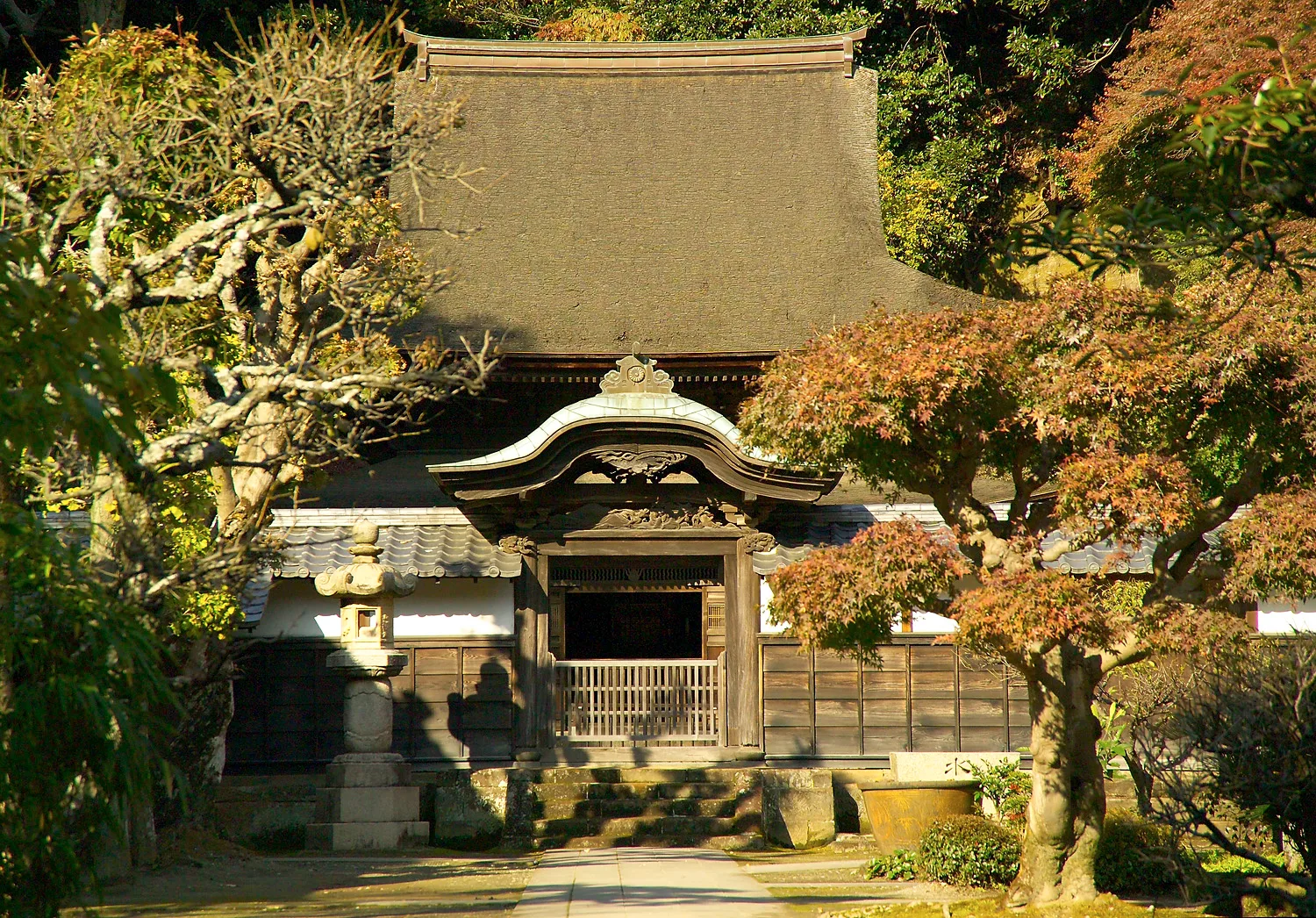
Engaku-ji is one of Kamakura's great Zen temples, and its gate is about a minute's walk from Kita-Kamakura Station. The grounds climb up a long valley lined with maples. Admission is 500 yen for adults, and from March to November it is open from 8:30 a.m. to 4:30 p.m. From December to February, it closes at 4:00 p.m.
Autumn maples in red and orange beside the Shariden hall at Engaku-ji temple in Kita-Kamakura
Maples turning color around the Shariden hall at Engaku-ji in Kita-Kamakura. Photo: Fg2 / Wikimedia Commons (public domain).
Kencho-ji, a short walk down the road, ranks first among Kamakura's five great Zen temples. It is open from 8:30 a.m. to 4:30 p.m., and admission is 500 yen for adults, paid in cash only. The Ten-en hiking course, which the city lists as one of its autumn leaf spots, starts from the hills behind the temple if you want a longer walk.
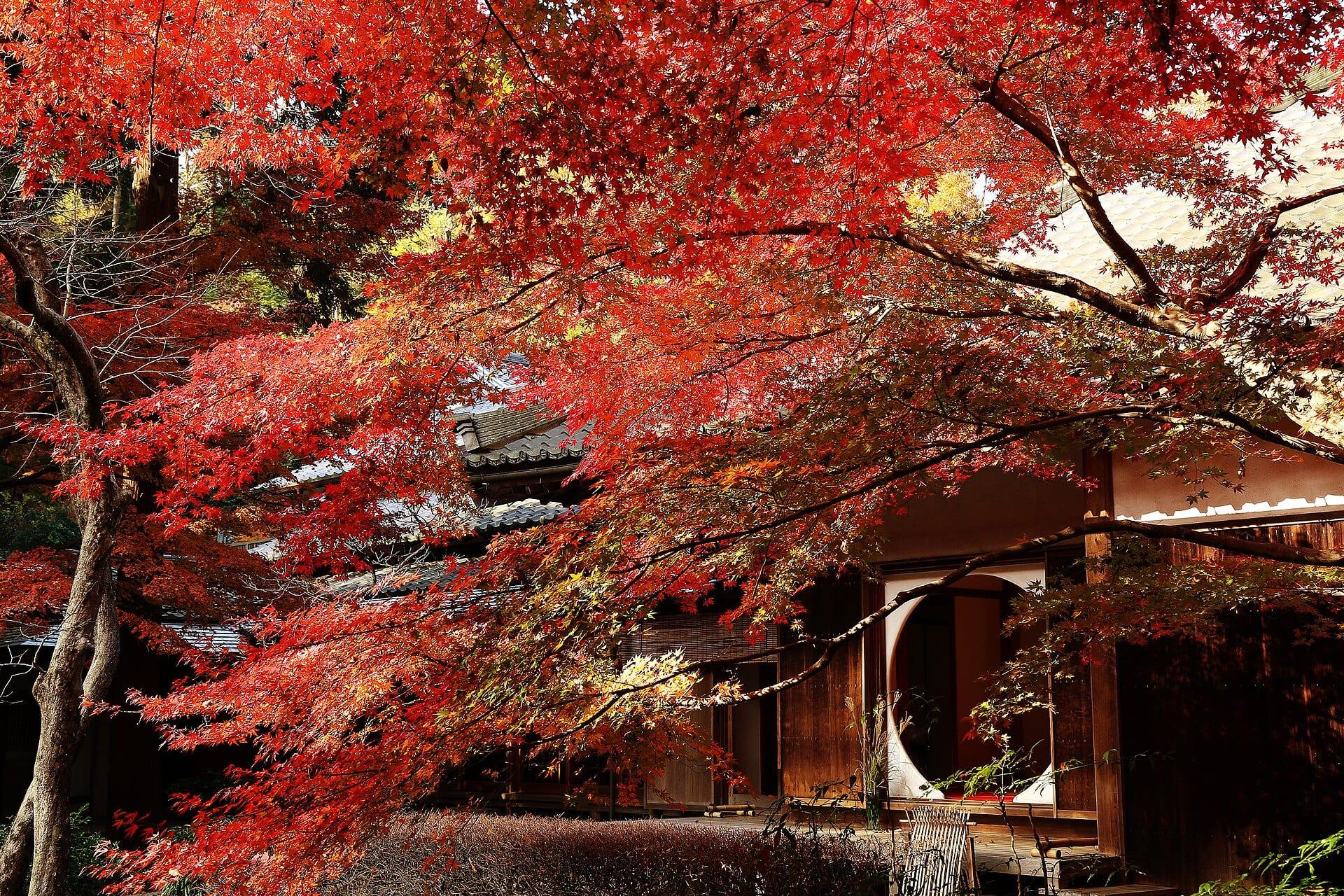
Meigetsu-in is best known for its hydrangeas in June, but it is also lovely in autumn. The garden behind the main hall is usually closed to visitors and opens only in the iris season and the autumn leaf season. Regular admission is 500 yen for adults, and the rear garden costs an extra 500 yen. The temple is open from 9:00 a.m. to 4:00 p.m. The view of the maples through the round window of the main hall is the shot most people come for.
Around Kamakura Station: Tsurugaoka Hachimangu
Tsurugaoka Hachimangu is Kamakura's main shrine, about a 10-minute walk from the east exit of Kamakura Station. The grounds are free to enter and open from 6:00 a.m. to 8:00 p.m. year round. Look for the yellow ginkgo near the main stone steps, where young trees grew back from the shrine's famous old ginkgo after it fell in a storm in 2010, and for the maples around the ponds. In late November 2025, the tourist association reported both the cherry trees along the Dankazura approach and these ginkgo trees in full fall color.
Hase: Hase-dera and its evening light-up
Hase-dera sits on a hillside a short walk from Hase Station on the Enoden line. Its gardens are planted on several levels, and a viewing deck looks out over the town to Sagami Bay. From July to March, the temple is open from 8:00 a.m. to 5:00 p.m., with last entry at 4:30 p.m. Admission is 400 yen for adults and 200 yen for children aged 6 to 11.
In autumn, Hase-dera also opens in the evening. We cover the 2026 dates in the light-ups section below.
The east side: Hokoku-ji, Zuisen-ji and Kakuon-ji
The quiet valleys east of Tsurugaoka Hachimangu tend to color a little later, which makes them a good choice for early December.
Hokoku-ji is famous for its bamboo grove, and in autumn the maples and ginkgo add red and yellow around the green. In 2025, the tourist association reported both at their best in early December. The temple is open from 9:00 a.m. to 4:00 p.m. Admission to the bamboo garden is 400 yen, and you can add a bowl of matcha with a small sweet for 600 yen in the tea house, served until 3:30 p.m.
Zuisen-ji, a little farther into the hills, is named in the city's seasonal guide as one of Kamakura's temple autumn leaf spots. The approach climbs through the woods, and it is far quieter than the temples in the town center.
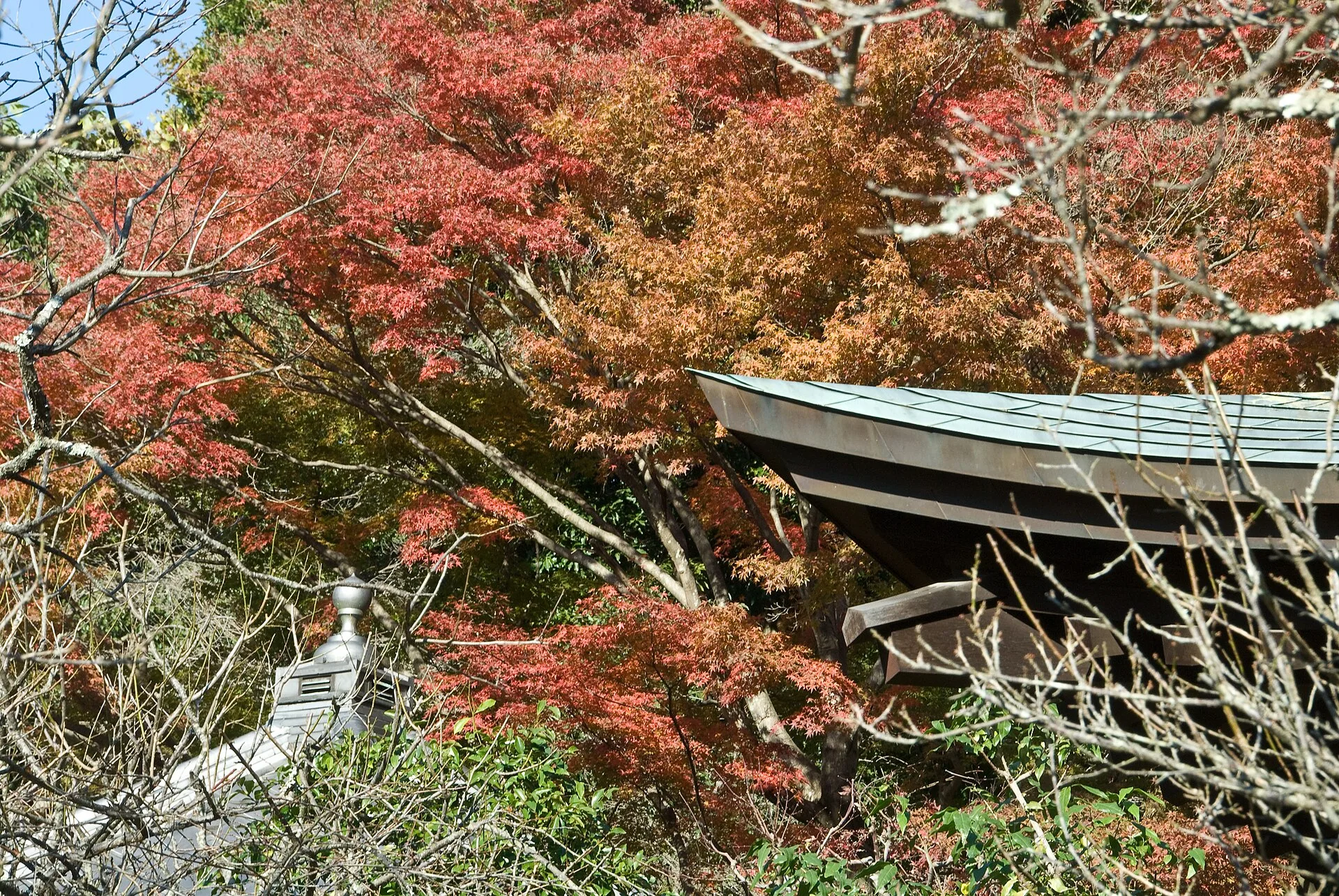
Red and orange autumn leaves over the curved roof of a temple building at Zuisen-ji in Kamakura
Autumn leaves around the buildings of Zuisen-ji, one of the quieter temples in the hills east of central Kamakura. Photo: Urashimataro / Wikimedia Commons (public domain).
Kakuon-ji is one of the last places in town to reach its peak. The tourist association says its leaves are usually at their best from late November to mid December, and the temple holds a special autumn opening at that time, covered below.
Autumn light-ups and special openings in 2026
Two temples hold special events for the leaf season this year. Both dates come from the temples and the Kamakura City Tourist Association.
Hase-dera autumn night viewing
From Saturday, November 21 to Sunday, December 6, 2026, Hase-dera stays open after dark. The lights come on around sunset, the gate closes at 7:00 p.m., and the grounds close at 7:30 p.m. Admission is the same as in the daytime, 400 yen for adults and 200 yen for elementary school students. The event goes ahead in light rain but may be canceled in bad weather, and the temple may extend it if the leaves are late. Tripods and monopods are not allowed.
A good plan is to arrive while it is still light, walk the gardens, and stay for the moment the lanterns come on.
Kakuon-ji special autumn opening
From Wednesday, November 25 to Thursday, December 10, 2026, Kakuon-ji extends its hours to 9:00 a.m. to 7:00 p.m., with last entry at 6:40 p.m., and lights the grounds in the evening. Admission is 500 yen for adults and 200 yen for elementary and junior high school students. The temple's usual rules still apply, which include no photography past the reception area.
Getting from Tokyo to Kamakura in November
The simplest route is the JR Yokosuka Line, which runs direct from Tokyo Station to Kita-Kamakura and Kamakura in about an hour. Since JR East revised its fares on March 14, 2026, the regular fare from Tokyo to Kamakura is 1,040 yen with a paper ticket and 1,034 yen with an IC card such as Suica or PASMO. From Shinjuku, the Shonan-Shinjuku Line costs the same 1,040 yen.
A few tips for the busy season:
Use an IC card. It is slightly cheaper, and you skip the ticket machine lines at Kamakura Station on the way home.
Start at Kita-Kamakura. Getting off one stop early lets you see the northern temples first and then walk or ride into Kamakura.
Take the Enoden to Hase. The small Enoden line runs from Kamakura Station to Hase Station in a few minutes, which beats sitting in traffic on the narrow roads.
A one-day route for Kamakura in November
This route follows the usual order in which the color moves through town. It works best on a weekday in the last week of November or the first few days of December.
Morning in Kita-Kamakura. Arrive at Kita-Kamakura Station around 8:30 a.m. and start at Engaku-ji as it opens. Then walk to Meigetsu-in and Kencho-ji.
Walk to Tsurugaoka Hachimangu. From Kencho-ji, it is about a 20-minute walk downhill to the shrine. Visit the ginkgo trees and the ponds.
Lunch near Komachi-dori. The busy shopping street by Kamakura Station has plenty of small restaurants. Eat before noon if you can, because lines grow fast on fall weekends.
Afternoon on the east side or in Hase. If it is early December, take a bus or taxi east to Hokoku-ji. If it is late November, ride the Enoden to Hase instead.
End at Hase-dera. During the light-up period, time your visit for the last hour of daylight, then stay for the lights.
Trying to cover both Hokoku-ji and Hase-dera in one afternoon is possible, but it means a lot of rushing between opposite ends of town. Choose one, and leave the other for a second visit.
Crowds, weather and what to bring
Autumn is one of Kamakura's busiest seasons. The tourist association's visitor data for November 2024 showed more than 40,000 people around Kamakura Station on several fine weekend days, including November 23 and November 30. Even Friday, November 22 passed that mark once the leaves turned, so a weekday is no guarantee. The first hour after the temples open is the quietest time on any day.
Late autumn days in Kamakura are usually mild enough for walking, but mornings and evenings get cool, especially in the shaded temple valleys. Wear layers, and bring a warmer jacket if you are staying for an evening light-up.
A few practical points:
Bring cash. Many temples, including Kencho-ji, take cash only.
Leave the tripod at home. Engaku-ji, Kencho-ji, Hase-dera and Hokoku-ji all ban tripods and monopods, and Kakuon-ji does not allow photography past its reception area.
Wear good shoes. Many temples have long flights of stone steps, and the leaves on them can be slippery after rain.
Is there a Kamakura festival in autumn?
You may read that the Kamakura Festival takes place in early October. It does not. The Kamakura Festival is a spring event, held in April, and in 2026 it ran from April 12 to April 19. The big autumn event at Tsurugaoka Hachimangu is its annual grand festival from September 14 to 16, which includes yabusame horseback archery on September 16.
Neither falls in the leaf season, so in late November and early December the seasonal highlights are the light-ups and special openings listed above. If you want festivals on the same trip, our guide to Yokohama's seasonal festivals covers what happens next door.
See Kamakura's autumn colors with a private driver guide
Kamakura is easy to reach by train, but the leaf season brings crowded platforms, packed buses and long walks between valleys. A private car lets you link the northern temples, Hase and the coast in one day without the transfers.
Our Kamakura Private Day Tour from Tokyo picks you up at your hotel in Tokyo's 23 wards and visits Tsurugaoka Hachimangu, the bamboo grove at Hokoku-ji, the Great Buddha, Hase-dera and Enoshima with an English-speaking driver guide. It starts at $500 USD for up to 2 guests in a sedan, with entrance tickets and lunch paid separately. To learn more about how pricing works, read our guide to what a Kamakura private tour costs.
If you have two days, the Kamakura & Yokohama 2-Day Private Tour from Tokyo pairs Kamakura's temples with a day in Yokohama, where the ginkgo trees turn a little later. Our guide to autumn foliage in Yokohama lists the best spots there. Browse the tours, pick your date and vehicle, and book online, or get in touch if you would like help planning your route.
Featured photo: Red maples around a temple building at Meigetsu-in in Kita-Kamakura, photographed in early December. Photo: Takayuki Suzuki / Wikimedia Commons (CC BY-SA 2.0).
TopicsKamakuraAutumn FoliageDay Trips from TokyoSeasonal Travel
Frequently Asked Questions
Yes, especially the second half of the month. The Kamakura City Tourist Association says the leaves start to turn in November around Kita-Kamakura Station, and the town as a whole usually reaches its best from late November to early December. In early November, most maples are still green.
No official 2026 peak date has been set. In a typical year, Kamakura is at its best from late November to early December, and a few later spots, such as Kakuon-ji, hold their color into mid December. A warm autumn pushes the peak later, so check the tourist association's color reports before you go.
Good choices include Engaku-ji, Kencho-ji and Meigetsu-in in Kita-Kamakura, Tsurugaoka Hachimangu near Kamakura Station, Hase-dera in Hase, and Hokoku-ji, Zuisen-ji and Kakuon-ji in the quieter hills to the east. The northern temples tend to turn first, and the eastern valleys a little later.
Since JR East revised its fares on March 14, 2026, the JR Yokosuka Line from Tokyo Station to Kamakura costs 1,040 yen with a paper ticket and 1,034 yen with an IC card such as Suica or PASMO. The direct train takes about an hour, and the Shonan-Shinjuku Line from Shinjuku costs the same 1,040 yen.
Yes. Hase-dera holds its autumn night viewing from November 21 to December 6, 2026, from sunset until the gate closes at 7:00 p.m., for 400 yen for adults. Kakuon-ji has a special autumn opening from November 25 to December 10, 2026, open from 9:00 a.m. to 7:00 p.m. with evening lighting, for 500 yen for adults.
Yes. Our Kamakura Private Day Tour from Tokyo picks you up at your hotel and visits Tsurugaoka Hachimangu, Hokoku-ji, the Great Buddha, Hase-dera and Enoshima with an English-speaking driver guide. It starts at $500 USD for up to 2 guests in a sedan, with entrance tickets and lunch paid separately.
Private tours for this destination
Ready to see it in person? These private tours cover the places in this guide.