
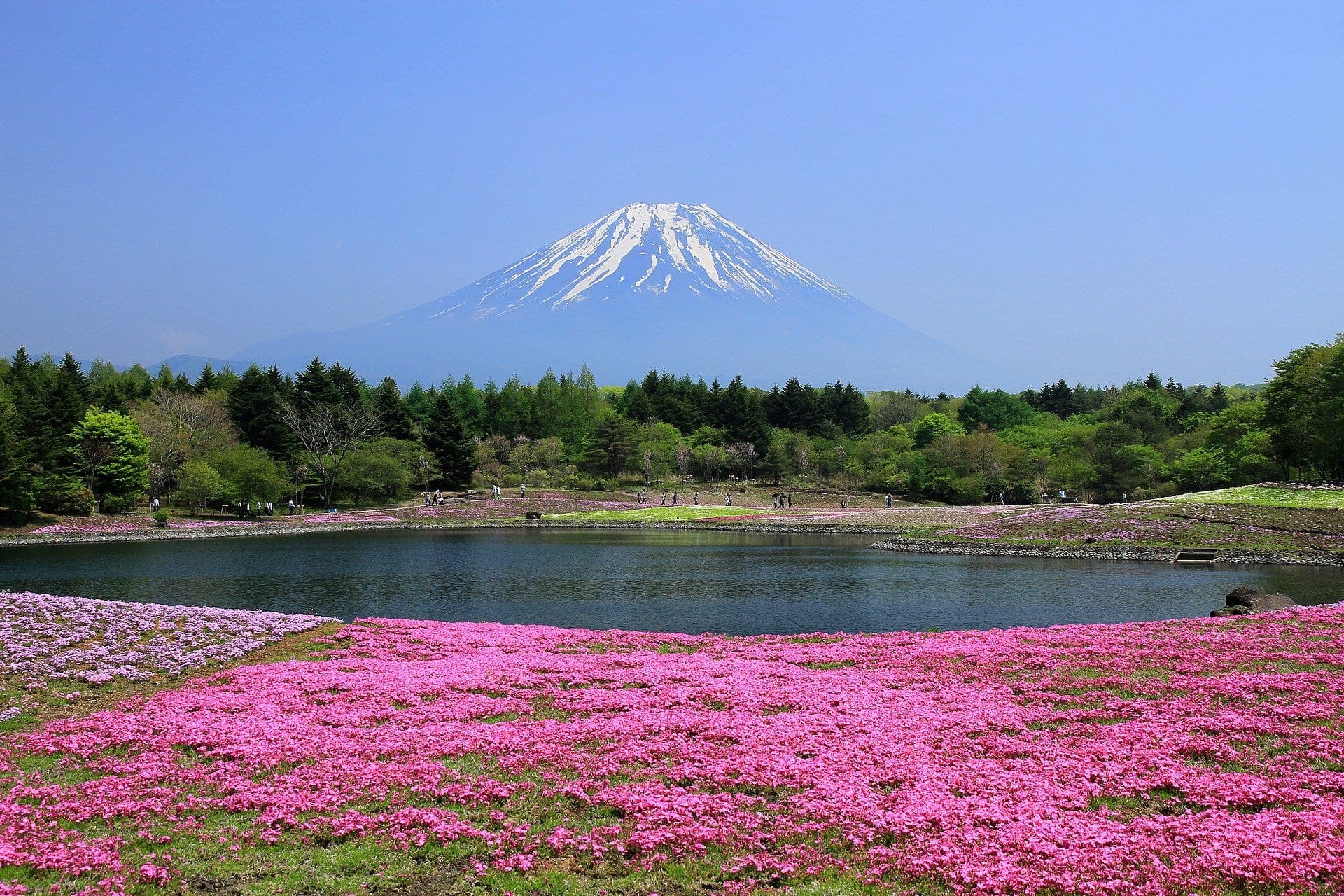
The Fuji Shibazakura Festival is the spring flower event where about 500,000 moss phlox plants cover the ground at the foot of Mount Fuji in shades of pink, red, purple, and white. It takes place every year at Fuji Motosuko Resort, near Lake Motosu on the Yamanashi side of the mountain. On a clear morning you get snowcapped Fuji above the flower fields, which is why so many people plan a spring trip around it. This guide covers when the festival usually runs, what tickets cost, how to get there from Tokyo and Kawaguchiko, and how to time your visit so you see more flowers than crowds.
Seasonal9 min read
Fuji Shibazakura Festival Guide: Dates, Tickets and Access
A practical guide to the Fuji Shibazakura Festival near Lake Motosu: usual dates and peak bloom, ticket prices and hours, the Shibazakura Liner bus, and how to plan a day around Mount Fuji.
By MickyEdited by Talha Nabeel
What is the Fuji Shibazakura Festival?
Shibazakura is the Japanese name for moss phlox (Phlox subulata), a low plant that spreads across the ground like a carpet. The name means "lawn cherry blossom," because each small flower looks a bit like a sakura petal. The plant is native to North America, but in Japan it has become one of the best known spring flowers.
At the festival, the shibazakura is planted across roughly 15,000 square meters of gently rolling ground, with Mount Fuji rising behind it. The organizers grow six varieties so the fields are not one flat color. You will see deep pink McDaniel's Cushion, rose pink Autumn Rose, white Montblanc, striped Tama no Nagare, pale purple Oakington Blue Eyes, and red Scarlet Flame. The colors are planted in bands and patches, so the view changes as you walk around.
The festival is run by a local organizing committee with support from Fujikawaguchiko Town and the Fuji Five Lakes tourism federation. The 2026 festival was the 19th one, so it has been part of spring around Fuji for close to two decades.
Fuji Shibazakura Festival dates and when to go
The festival runs for about six weeks each spring. In 2026 it opened on April 11 and closed on May 24, with no closing days during that period. Dates for 2027 had not been announced when this guide was written in late October 2026. Recent festivals have started in mid-April and finished in late May, and the organizers note that dates can shift with the bloom. Look at the official Fuji Motosuko Resort website in early spring for the new dates.
The flowers do not all open on day one. The site sits high on the northern slope of Fuji, so spring comes later here than in Tokyo. In most years the fields fill in from late April into early May. That is also when the festival charges its higher ticket price, which tells you when the organizers expect the best color. Early in the season you may see patchy fields, and near the end some areas start to fade.
The festival posts bloom updates on its official Instagram account, so check it a few days before you go.
Picking a day and a time
Golden Week, from late April to early May, brings the biggest crowds and the worst traffic on the roads around the lakes. If you can, go on a weekday outside that week.
Morning is the best time of day for two reasons. The festival opens at 8:00, before most tour buses arrive, and Mount Fuji is more often clear in the early hours. Clouds tend to build around the summit by late morning, and on some days the mountain disappears completely by noon. If the forecast shows heavy cloud, the flowers are still worth seeing, but you may not get the classic photo with Fuji behind them.
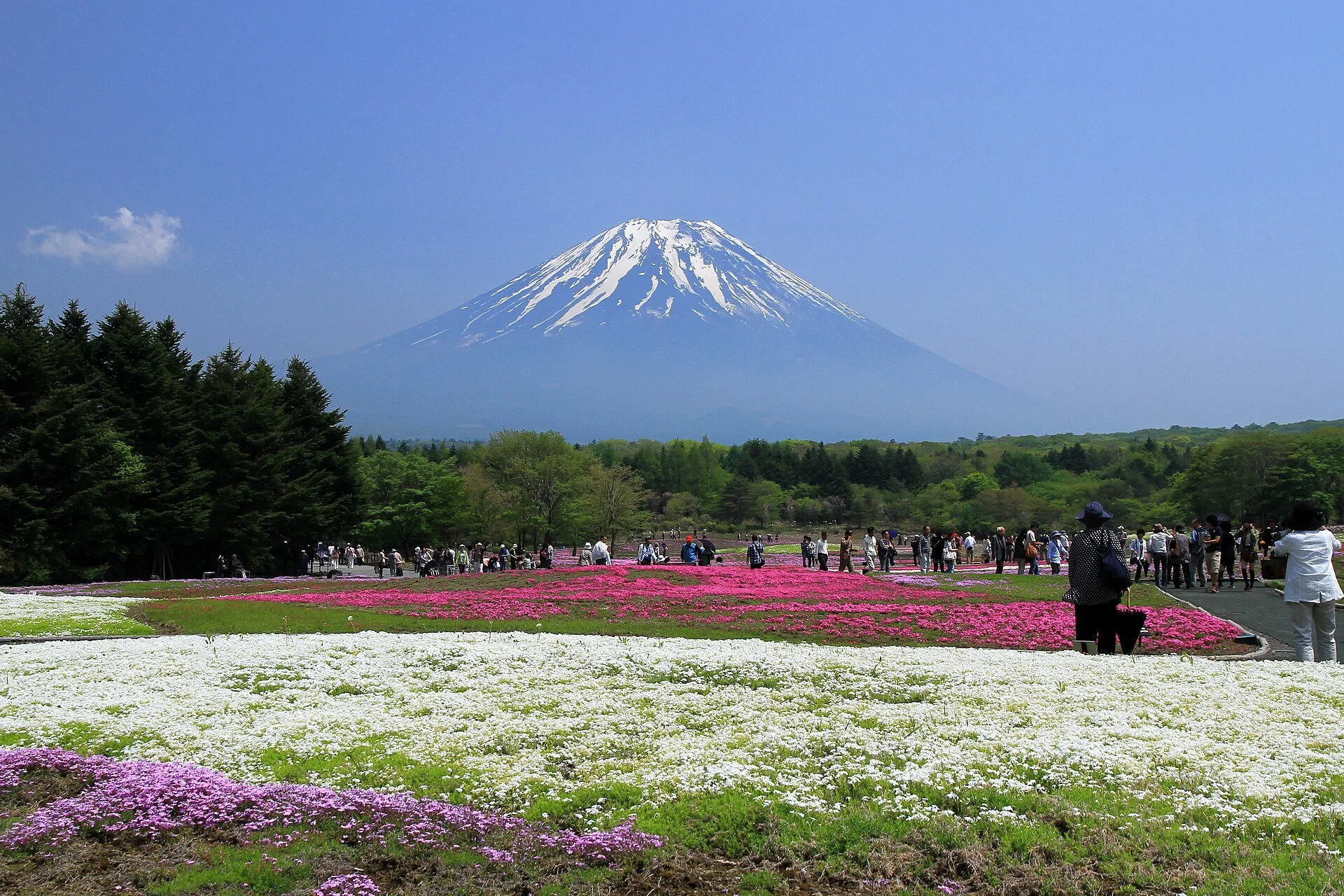
Pink and white shibazakura fields with Mount Fuji behind them at Fuji Motosuko Resort. Photo: 京浜にけ / Wikimedia Commons (CC BY-SA 3.0).
Tickets and opening hours
Here is what the 2026 festival charged. Expect similar prices in 2027, but confirm them on the official site before you go.
-
Hours: 8:00 to 16:00, with changes on some days during the season.
-
Adults (junior high school age and up): 1,000 yen on regular days and 1,300 yen during the peak period.
-
Children (age 3 and up): 500 yen on regular days and 700 yen during the peak period.
-
Peak period in 2026: April 25 to May 10.
You can buy tickets at the gate. The festival also sells dated online tickets called Shiba Ticket through Fujikyu Travel. If you buy by the day before your visit, the adult ticket is 100 yen cheaper, and you skip the ticket line and go straight to the Shiba Ticket booth.
The Peter Rabbit English Garden sits on the same grounds and opens for spring on the same day as the festival, following the festival's hours and admission. It is a British style garden based on the Beatrix Potter books, with a cafe and a shop. If you have children with you, it is a nice break from the open fields.
How to get to the Fuji Shibazakura Festival
The venue is out in the countryside near Lake Motosu, the westernmost of the main Fuji Five Lakes. There is no train station nearby, so you will finish the trip by bus or car.
By train and the Shibazakura Liner bus
Most visitors using public transportation go through Kawaguchiko Station. From Shinjuku, the Fuji Excursion limited express runs straight through to Kawaguchiko, or you can take the JR Chuo Line to Otsuki and change to the Fujikyu Railway. The Fuji Excursion takes about two hours, and the route with a change at Otsuki usually takes a little longer. Check train times and fares on the JR East and Fujikyu Railway websites, since they change by season.
From Kawaguchiko Station, the Shibazakura Liner bus leaves from bus stop 7 and runs straight to the festival with no stops along the way. The ride takes about 40 minutes when the roads are clear. In 2026, buses left Kawaguchiko about once an hour from 8:35 to 14:15, with extra early and late buses from April 29 to May 6. The last regular bus back to Kawaguchiko left the festival at 16:00.
The best value is the set ticket. In 2026, a round trip on the Shibazakura Liner plus festival admission cost 3,000 yen for adults and 1,500 yen for children. Fujikyu also sold a version with a two day pass for the Fujikyu Railway for 4,800 yen. Buy it online in advance and you can board the bus without lining up at the station ticket window.
By direct highway bus from Tokyo
In 2026, Fujikyu sold a package with a round trip highway bus from Busta Shinjuku straight to the festival plus admission for 6,400 yen. The bus left Shinjuku at 7:35 and reached the venue around 10:00, with return buses in the early afternoon. This is the simplest option if you do not want to change trains, but seats are limited, so book early.
From the Shizuoka side
If you are coming from the Tokaido Shinkansen, local buses and a Shibazakura Liner also run from Shin-Fuji Station and Fujinomiya Station to the venue. There are only a few buses a day, so plan around the timetable on the official site.
By car
Driving gives you the most freedom, especially if you want to see other spots around the lakes on the same day. The festival has a paid parking lot. On weekends and during Golden Week, the roads near the venue back up badly in the late morning. Arriving close to opening time makes a big difference.
What to see and do at the festival
The main thing to do is walk. Paths run between the flower beds, so you can wander right through the fields with Mount Fuji ahead of you. Give yourself at least an hour and a half for the flowers alone, and more if you plan to visit the English garden or stop for food.
In past years the festival has planted a small hill of pink shibazakura in the shape of Mount Fuji, and it has been one of the most photographed spots on site. On a clear day you can line it up with the real mountain behind it. The festival also sets up photo props each year. In 2026 these included a heart-shaped bench, a door frame standing in the flowers, a small boat in a sea of pink, and a new mirror installation.
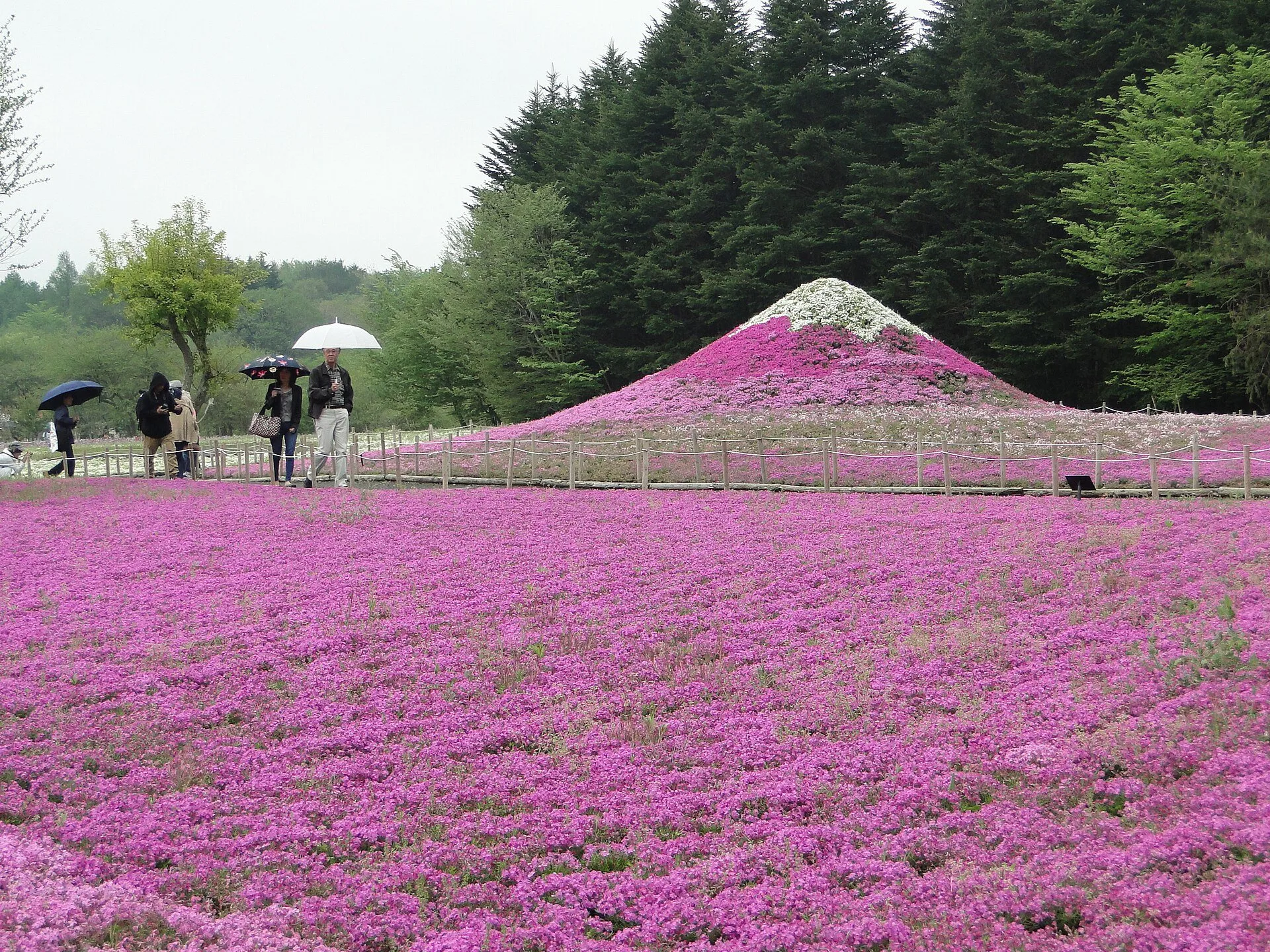
A small hill of pink shibazakura shaped like Mount Fuji at the Fuji Shibazakura Festival. Photo: Ankur P / Wikimedia Commons (CC BY 2.0).
Food and souvenirs
Food trucks and stalls set up inside the venue during the festival. In 2026 they sold local favorites like Fujinomiya yakisoba and Yoshida udon, a thick, chewy noodle from the Fujiyoshida area. There were also spring snacks such as churros shaped like the kanji for cherry blossom and fried bread topped with soft serve ice cream. The Peter Rabbit garden cafe serves sit-down meals.
The shop on site sells souvenirs made for the festival, including a shibazakura version of Kikyo Shingen mochi, a well-known sweet from Yamanashi. Bring some cash for smaller stalls.
Bringing your dog
Small and medium dogs up to 50 cm tall can enter. In 2026, dogs on a leash were allowed outside the busiest periods. During Golden Week and when the venue is crowded, dogs must stay in a carrier, cart, or sling.
Tips for a better visit
A few simple things help a lot on festival day:
-
Buy your Shiba Ticket or bus set ticket online the day before. Lines at the Kawaguchiko Station ticket window get long on weekends.
-
Wear shoes you can walk in on dirt and gravel paths. The ground can be muddy after rain.
-
Bring a warm layer. The site sits at a higher elevation than Tokyo, and spring mornings can feel cold even when the afternoon is mild.
-
Pack sunscreen and a hat. There is very little shade in the flower fields.
-
Leave extra time for the trip back. On holidays, traffic can delay buses, so do not book a tight train connection in the afternoon.
-
Stay on the paths. The flowers are planted close together and are easily damaged if people step into the beds for photos.
Combining the festival with other Fuji sights
The festival only needs a half day, so most people pair it with other stops around the Fuji Five Lakes. Lake Kawaguchi is the obvious base, with views of Fuji across the water from its northern shore. The Chureito Pagoda at Arakurayama Sengen Park is another popular spring stop, with the five-story pagoda framed against the mountain. Our guide to Mt. Fuji viewpoints around Kawaguchiko has more ideas for spots that are less crowded.
If you plan to spend a night in the area, a ryokan near Lake Kawaguchi lets you start early and reach the festival before the day trip crowds. Our guide to ryokan stays in Japan explains what to expect from a traditional inn, from dinner to the shared baths.
Doing it all in one day from Tokyo is possible, but it is a long day with several transfers. For a comparison of train, bus, and private car options, read our Mount Fuji day trip planning guide.
Visiting with a private driver and guide
A private car takes most of the hassle out of a Fuji Shibazakura Festival day. You leave Tokyo early, reach the fields close to opening time, and skip the bus lines at Kawaguchiko. Afterward, you can move on to Lake Kawaguchi and the Chureito Pagoda without waiting for connections.
Our Mt. Fuji private day tour from Tokyo includes hotel pickup in Tokyo, fuel, tolls, and parking, priced per vehicle, with stops at Lake Kawaguchi, the Chureito Pagoda at Arakura Sengen Shrine, and Oshino Hakkai. If you are visiting in late April or May and want the festival included in your day, contact us and we will help you plan a custom route around the bloom.
Featured photo: Mount Fuji and shibazakura at Fuji Motosuko Resort. Photo: 京浜にけ / Wikimedia Commons (CC BY-SA 3.0).
TopicsMt FujiFuji Five LakesSpringFestivalsDay Trips
Frequently Asked Questions
Private tours for this destination
Ready to see it in person? These private tours cover the places in this guide.
Related posts
Ready to explore Japan?
Book a private tour with OHAYO TRAVEL JAPAN.
View all private tours · Browse by category · Destinations · Contact us