Zojoji Temple: Hours, Tickets and Tokyo Tower Views
Zojoji Temple sits beside Tokyo Tower in Shiba Park. Here are the official hours, mausoleum ticket prices, Treasures Gallery details, Jizo statues and the closest stations.
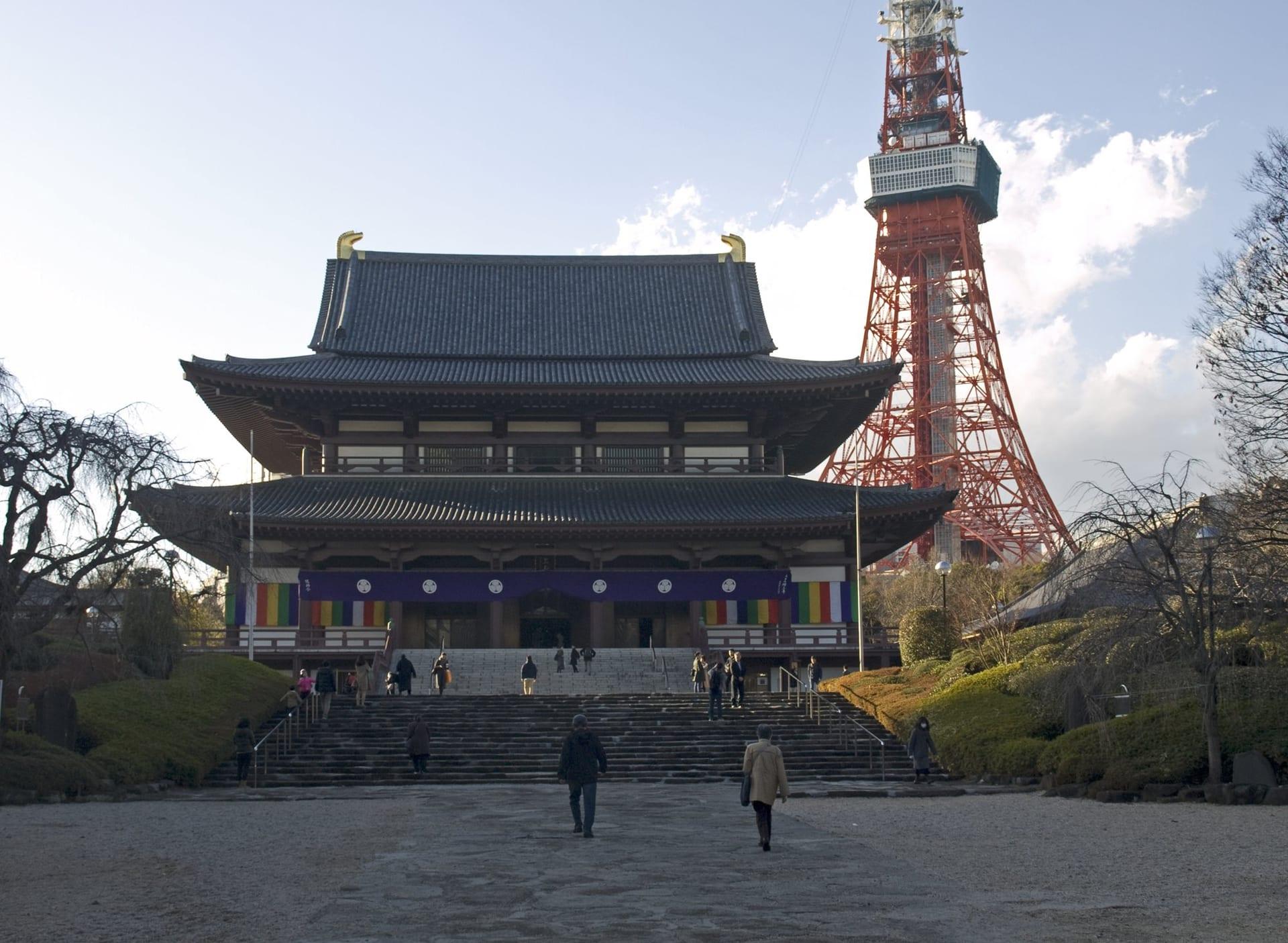
Zojoji Temple sits beside Tokyo Tower in Shiba Park, in Tokyo's Minato ward. The grounds and the main hall do not require a ticket, so you can walk in during posted hours and still add the paid mausoleum or Treasures Gallery if you want more time with the Tokugawa history. This guide covers current hours, ticket prices, the Jizo statues, temple etiquette and the nearest stations. I checked the official Zojo-ji pages on November 12, 2026.
If you are also mapping other temples in the city, our guide to Tokyo's top temples covers a wider circuit, including places such as Senso-ji. This page stays with one site: 増上寺, usually written Zojoji or Zojo-ji in English. The hours, ticket prices and current closures below come from the official temple site, including the English pages and the Japanese notices for the graveyard and the gate restoration.
Zojoji Temple hours and admission
The official FAQ lists these hours for the halls you can enter without a ticket:
Main hall (Daiden): 6:00 a.m. to 5:30 p.m., daily
Ankokuden: 9:00 a.m. to 5:00 p.m., daily
Goshuin stamps and amulets are sold at Ankokuden during those same hours. The official site also notes an elevator in the main hall and wheelchairs you can borrow. There is no general visitor parking, so come by train or on foot.
The Treasures Gallery and the Tokugawa Shogunate Graveyard are separate, ticketed spaces with shorter hours, and they close on Tuesdays unless that Tuesday is a national holiday:
Weekdays: 11:00 a.m. to 3:00 p.m., last entry 2:45 p.m.
Saturdays, Sundays and national holidays: 10:00 a.m. to 4:00 p.m., last entry 3:45 p.m.
Ticket prices, also from the official pages:
Treasures Gallery: ¥700 for adults, ¥300 for junior high and high school students, free for elementary students and younger
Tokugawa Shogunate Graveyard: ¥500 for adults, free for high school students and younger
Combined ticket for both: ¥1,000
The graveyard page states that there are no disability or group discounts on that ticket.
A simple visit can follow this order:
Walk through the Sangedatsumon, which you can still do under the temporary roof
Enter the main hall, then Ankokuden if you want a goshuin stamp
Continue to the Jizo statues on the north side of the grounds
Stop on the precincts for the view of Tokyo Tower above the hall
Add the Treasures Gallery, and the graveyard once it reopens
The main hall opens early enough that you can sit in on the 6:00 a.m. morning service if you arrive at opening time.
The Tokugawa mausoleum, and a closure through December 1, 2026
Zojoji became the family temple of the Tokugawa after Tokugawa Ieyasu entered Edo in 1590 and the temple moved to this site in 1598. The temple itself was founded earlier, in 1393, by the priest Yuyo Shoso of the Jodo-shu (Pure Land) school. Ieyasu is not buried here; his shrine is at Nikko. Six later shoguns are.
The graveyard on the grounds holds the tombs of the second shogun, Hidetada; the sixth, Ienobu; the seventh, Ietsugu; the ninth, Ieshige; the twelfth, Ieyoshi; and the fourteenth, Iemochi. Consorts are buried here as well, including Princess Kazunomiya (Seikan'in). The original mausoleums were lost in the 1945 air raids and later rebuilt. The remains were reinterred in 1958.
As of the official notice dated November 1, 2026, the Tokugawa Shogunate Graveyard is closed from October 27 through December 1, 2026, while the ticket office is rebuilt. The Treasures Gallery stays open on its usual days during this work. After December 1, the hours and ¥500 adult ticket above apply again, unless the temple posts a new notice.
The Treasures Gallery
The gallery sits on the basement floor of the main hall. Its centerpiece is a 1:10 model of the Taitokuin Mausoleum, the tomb of the second shogun, Hidetada. The model was made for the 1910 Japan-British Exhibition and later came back to Zojoji on loan from the Royal Collection. It has been on display since 2015, and it is about four meters by six meters.
A rotating selection of the Five Hundred Arhats scrolls by Kano Kazunobu is usually on view as well. If you are visiting after the graveyard reopens, the ¥1,000 combined ticket is the cheaper way to see both.
The Sangedatsumon gate and the Tokyo Tower view
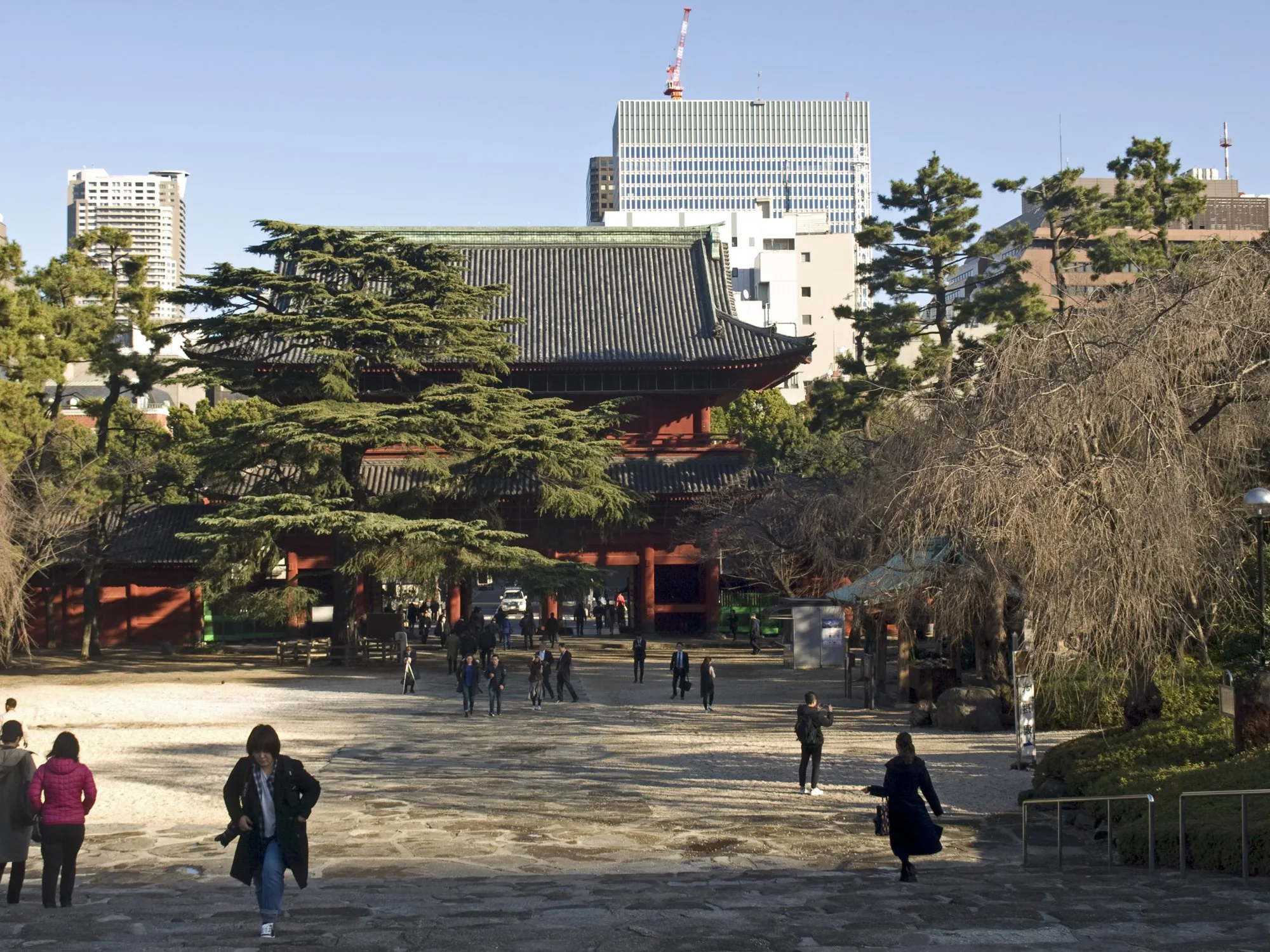
The Sangedatsumon is the temple's inner gate and an Important Cultural Property. It was built in 1611, collapsed in a storm in 1621, and was rebuilt in 1622. It is the only building left from the temple's early Edo construction. The upper floor is not open to the public.
The gate is now under a long restoration. The official precincts page lists the work as January 2025 through June 2032, with completion expected around autumn 2032. A June 1, 2026 progress report from the temple says the temporary roof is in place and you can walk through the passage under it. The photo below shows the gate as it looked in 2018, before that cover went up.
Tokyo Tower stands just beyond the grounds in Shiba Park, and the hall and the tower share the same sightline from several points on the precincts. You do not need a ticket to stand on the grounds and take that view.
The temple's large bell, the Daibonsho, was completed in 1673 after seven castings. Official figures give a diameter of 1.76 meters, a height of 3.33 meters and a weight of 15 tons. It is one of the three great bells of Edo, and it is still tolled twice a day, six times in the morning and six times in the evening.
The Jizo statues
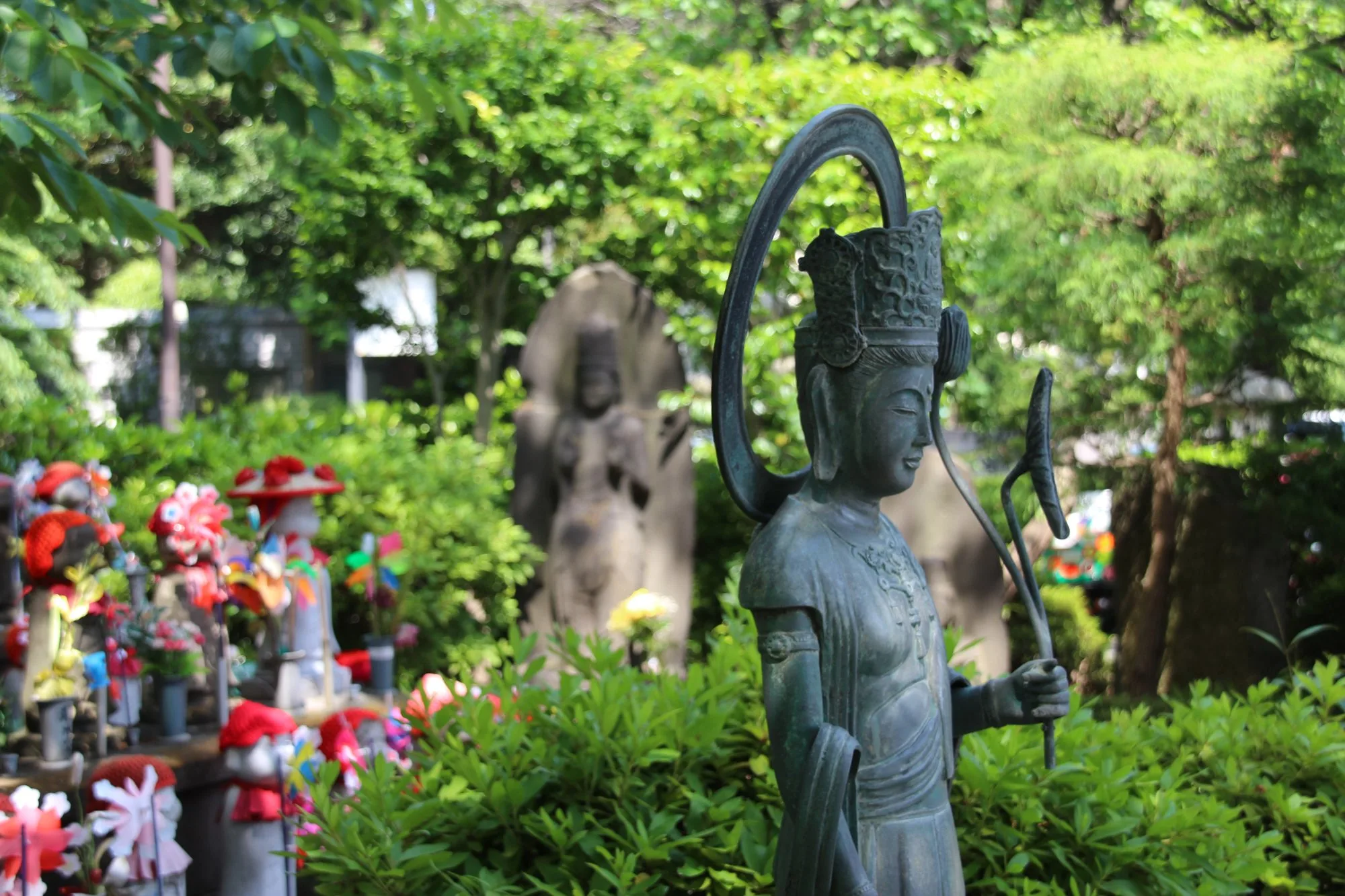
On the north side of the grounds you will find the Sentai Kosodate Jizo, a field of about 1,300 small Jizo statues. The official event page says the figures have been placed here since 1975, for children's healthy growth and as a memorial for children lost before birth. The temple holds a memorial service on the third Sunday in April, and a Bon dance is held in July.
The rows are easy to walk past in a few minutes. Keep your voice low and do not treat the statues as a photo prop. If you want to leave an offering, follow the signs on site.
Rows of small Jizo statues on the grounds of Zojoji Temple
Zojoji is a Buddhist temple, not a Shinto shrine, and the prayer form is different. At a shrine you clap. At a temple you do not.
The official FAQ gives the Jodo-shu practice used here. In front of the image of Amida, join your palms, bow, recite "Namu Amida Butsu" ten times, and bow again. You can also make a small coin offering before you pray.
A Sunday sermon is held in the main hall at 9:00 a.m. and is open to anyone. The Black Image of Amida in Ankokuden is unveiled on January 15, May 15 and September 15, from 10:00 a.m. to 4:00 p.m., with a prayer service at 2:00 p.m. on those days.
The official address is 4-7-35 Shibakoen, Minato-ku, Tokyo. The temple's access page lists these stations:
Onarimon or Shibakoen on the Toei Mita Line, about a 3-minute walk
Daimon on the Toei Asakusa and Oedo lines, about a 5-minute walk
Akabanebashi on the Toei Oedo Line, about a 7-minute walk
Hamamatsucho on the JR Yamanote and Keihin-Tohoku lines, or the Tokyo Monorail, about a 10-minute walk
Kamiyacho on the Tokyo Metro Hibiya Line, about a 10-minute walk
If you are already on the JR Yamanote Line, Hamamatsucho is the simple choice, then a 10-minute walk through the Shiba Park area. Onarimon is closer if you are on the Toei Mita Line. There is no general visitor parking, which the official FAQ states clearly, so public transit is the practical way in.
A walk around the grounds and the main hall can take 30 to 45 minutes. Add another 30 to 45 minutes if the graveyard is open and you also go into the gallery. If you come while the graveyard is still closed, the hall, the Jizo statues, the tower view and the gallery are still enough for a first visit.
If you would rather visit Zojoji with a private guide, our Tokyo Temples and Japanese Gardens Private Day Tour starts at $450 for two people in a sedan. The day is built around temple and garden stops rather than a rushed circuit, and it is a straightforward way to see this site alongside other places in the city.
Yes. The grounds, the main hall and Ankokuden do not require a ticket. The Treasures Gallery is ¥700 for adults, and the Tokugawa Shogunate Graveyard is a separate ¥500 adult ticket. A combined ticket for both paid areas is ¥1,000. Those prices come from the official Zojo-ji pages, checked on November 12, 2026.
The main hall is open from 6:00 a.m. to 5:30 p.m., and Ankokuden is open from 9:00 a.m. to 5:00 p.m. The Treasures Gallery and the Tokugawa graveyard are open 11:00 a.m. to 3:00 p.m. on weekdays, last entry 2:45 p.m., and 10:00 a.m. to 4:00 p.m. on Saturdays, Sundays and national holidays, last entry 3:45 p.m. Both paid areas close on Tuesdays unless that Tuesday is a national holiday.
The official adult ticket for the Tokugawa Shogunate Graveyard is ¥500. High school students and younger enter free. A combined ticket with the Treasures Gallery is ¥1,000. The graveyard page states that there are no disability or group discounts on that ticket.
No. An official notice dated November 1, 2026 says the graveyard is closed from October 27 through December 1, 2026, while the ticket office is rebuilt. The Treasures Gallery stays open on its usual days during this work. After December 1, the normal hours and the ¥500 adult ticket apply again unless the temple posts a new notice.
The official address is 4-7-35 Shibakoen, Minato-ku, Tokyo. The closest stations are Onarimon and Shibakoen on the Toei Mita Line, each about a 3-minute walk, and Daimon on the Toei Asakusa and Oedo lines, about a 5-minute walk. Hamamatsucho on JR and the Tokyo Monorail, and Kamiyacho on the Hibiya Line, are about a 10-minute walk. There is no general visitor parking.
No. Zojoji is a Buddhist temple, not a Shinto shrine, so you do not clap. The official FAQ gives the Jodo-shu form used here: in front of the image of Amida, join your palms, bow, recite "Namu Amida Butsu" ten times, and bow again. You can also make a small coin offering before you pray.
Private tours for this destination
Ready to see it in person? These private tours cover the places in this guide.