Rinnoji Temple is the main Buddhist temple in Nikko's Sannai precinct. This guide covers official hours and tickets for Sanbutsudo and Taiyuin, how to behave at the nearby shrines, and access from Tokyo.
Rinnoji Temple sits in the Sannai precinct of Nikko, the same hillside as Toshogu and Futarasan Shrine, and it is the main Buddhist temple in that group. A lot of visitors rush past it on the way to Toshogu's carvings. If you give the halls some time, you get a clearer sense of how the precinct works: a temple founded more than 1,200 years ago, a later Tokugawa mausoleum that belongs to the same temple, and two shrines next door that follow a different ritual.
I checked official pages from Rinnoji Temple, Nikko City tourism (Nikko Tabi Navi), Tochigi prefecture tourism, Visit Nikko, and Futarasan Shrine on November 16, 2026. Fees and hours below come from those pages. They can change on ritual days, so confirm your date on the official Rinnoji information page before you go.
For Toshogu tickets and carvings, use our Nikko Toshogu Shrine guide. For trains and whether a single day is enough, see Is a day trip to Nikko from Tokyo worth it?. This article stays with Rinnoji Temple, how to visit it respectfully, and the shrines you will pass on the same walk.
What Rinnoji Temple is
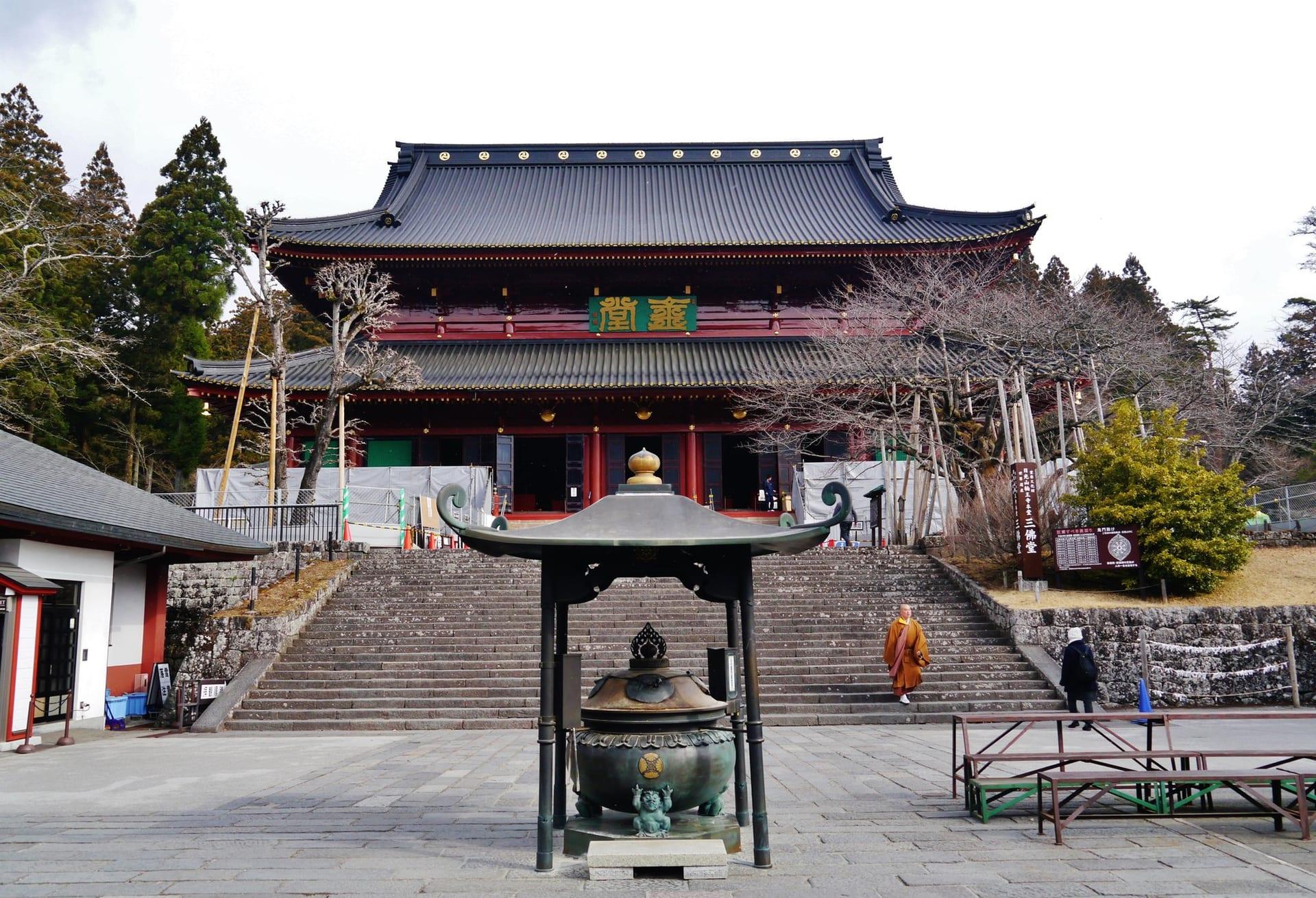
Official Visit Nikko describes Rinnoji Temple as a temple with more than 1,200 years of history, founded by the priest Shodo Shonin. It was first known as Shihonryuji. The main hall, Sanbutsudo, houses three large Buddhist statues, each about eight meters tall: Senju-Kannon, linked with Mt. Nantai; Amida, linked with Mt. Nyoho; and Bato-Kannon, linked with Mt. Taro, the three sacred mountains of Nikko.
Taiyuin, a short walk from Sanbutsudo, is the mausoleum of the third Tokugawa shogun, Iemitsu, and it is part of Rinnoji Temple, not a separate shrine. The temple also keeps a treasure house and the Shoyoen garden next to Sanbutsudo, and a hall at Lake Chuzenji, which is a separate outing from a Sannai day.
The address on the official site is 2300 Sannai, Nikko. The official telephone number is 0288-54-0531.
Hours and tickets at Rinnoji Temple
The official Rinnoji information page lists these hours for the halls that sell tickets: 8:00 a.m. to 5:00 p.m. from April through October, and 8:00 a.m. to 4:00 p.m. from November through March. Last entry is 30 minutes before closing. That earlier opening matters on a busy day, because Toshogu officially opens at 9:00 a.m.
Single tickets, from the same official page:
Sanbutsudo: ¥400 for adults, ¥200 for elementary and junior high students. The temple suggests 10 to 20 minutes inside.
Taiyuin: ¥550 for adults, ¥250 for elementary and junior high students. Allow 30 to 60 minutes.
Treasure House and Shoyoen garden: ¥300 for adults, ¥100 for elementary and junior high students. Allow 20 to 30 minutes.
Set tickets:
Rinnoji set (Sanbutsudo and Taiyuin): ¥900 for adults, ¥400 for elementary and junior high students. Official suggested time is one and a half to two hours. These tickets are sold only until 2:30 p.m. from April through October, and until 1:30 p.m. from November through March.
Full set (Sanbutsudo, Taiyuin, and the Treasure House): ¥1,000 for adults, ¥500 for elementary and junior high students. Official suggested time is two to two and a half hours. This set is sold only at the Sanbutsudo ticket office or as an official e-ticket. You cannot buy it at Taiyuin or at the Treasure House, and the temple says agency, group, and coupon tickets are not accepted for it.
The official page also says the old World Heritage combined ticket that covered several shrines and temples (the 社寺共通拝観券) is currently suspended. Do not plan your budget around that pass until Rinnoji says it is back on sale.
Some halls close or limit entry on ritual days. Official 2026 and early 2027 examples include Sanbutsudo closed all day on February 3, from 11:00 a.m. on April 1, all day on April 2, and in the morning on December 14; limited access to the Taiyuin worship hall on April 18 to 20, May 17, and July 14 to 15; and Treasure House closed days on May 26, July 29, September 30, and November 25, 2026, plus January 27 and March 25, 2027. Use the official information page for the date you travel, because the list is longer than this and can be updated.
Sanbutsudo and the three Buddhas
Start at Sanbutsudo if you want a quieter first stop. The hall opens at 8:00 a.m., and many groups go to Toshogu first. You will likely remove your shoes before you go in, so wear a pair that comes off easily. The three statues are the reason for the hall's name, which means "Hall of the Three Buddhas." Give yourself a few unhurried minutes in front of them rather than treating the room as a corridor.
Photography rules are posted on site. Follow the signs at each hall instead of assuming a single rule for the whole precinct. Some interiors restrict photographs. There is no photography permit fee on the official Rinnoji pages I checked.
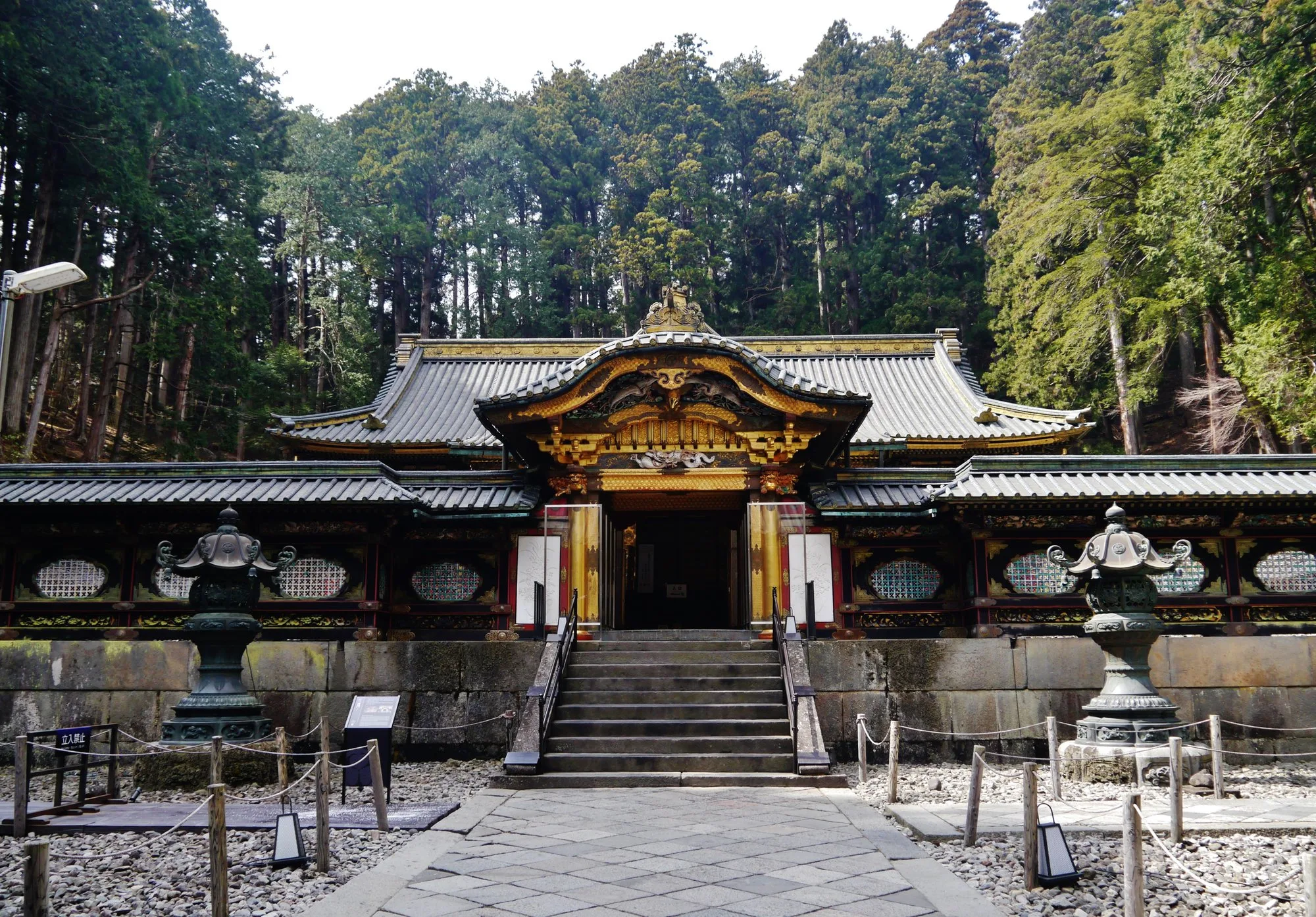
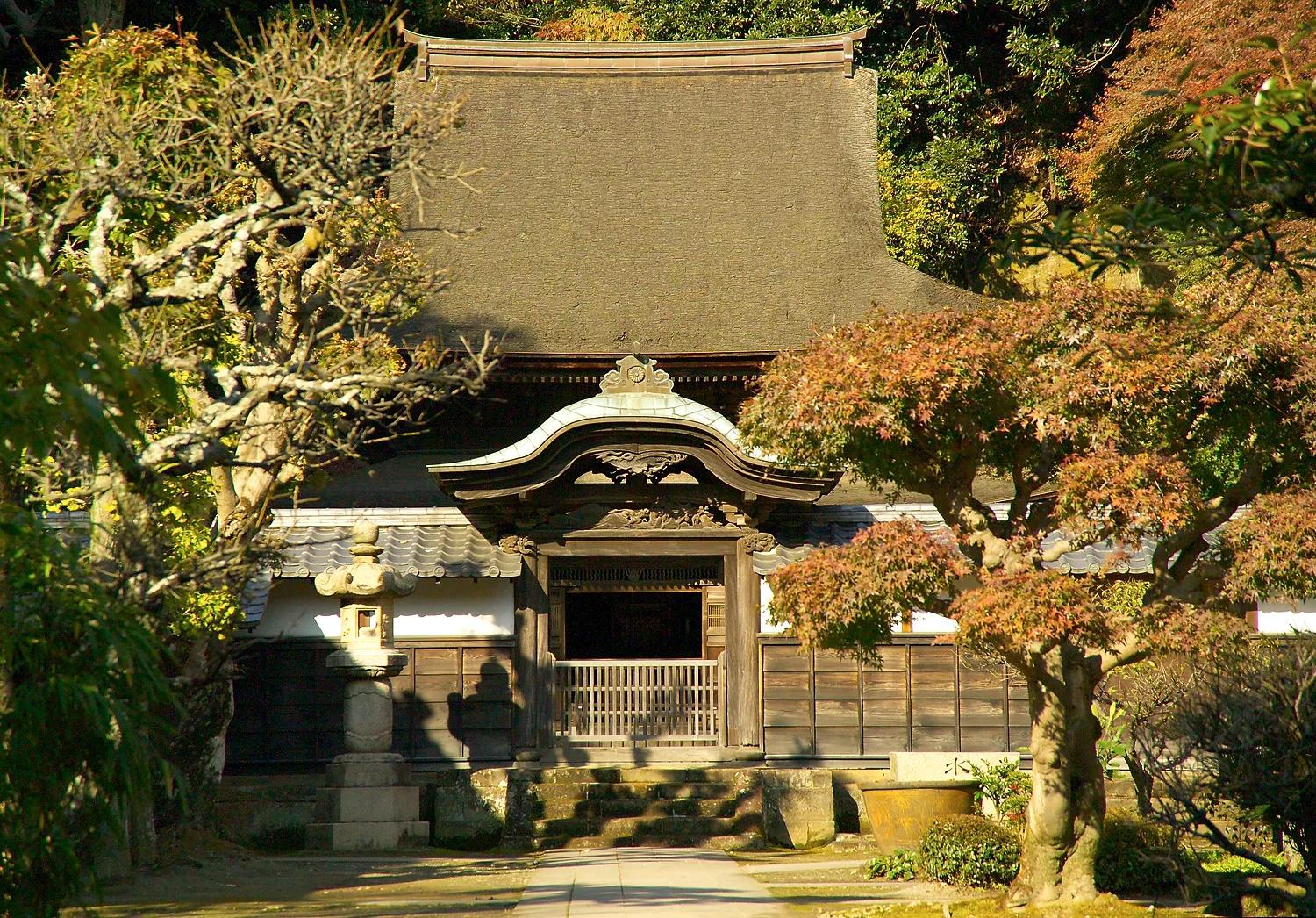
The carved Kara-mon gate at Taiyuin, the mausoleum of Tokugawa Iemitsu at Rinnoji Temple in Nikko
The Kara-mon gate at Taiyuin, Iemitsu's mausoleum, a short walk from Sanbutsudo on the same temple grounds. Photo:Zairon / Wikimedia Commons,CC BY-SA 4.0.
Taiyuin, the mausoleum of Tokugawa Iemitsu
Taiyuin sits a short walk from Sanbutsudo, through a quieter stretch of the precinct. It is often compared with Toshogu, which is the shrine and mausoleum of Iemitsu's grandfather, Ieyasu. The two sites are close, but they are not the same kind of place: Toshogu is a shrine, and Taiyuin belongs to Rinnoji Temple.
If you want both Sanbutsudo and Taiyuin, buy the Rinnoji set or the full set at Sanbutsudo in the earlier part of the day. The official sale cutoff for the Rinnoji set is 2:30 p.m. in the April to October season and 1:30 p.m. in winter, and the full set is not sold at the Taiyuin ticket window. The temple's own time guide for Taiyuin is 30 to 60 minutes, which is longer than a Sanbutsudo visit.
The path, gates, and halls repay a slower walk. Stay on the marked routes, keep your voice down, and wait if a prayer or a small group is already in a doorway.
How to behave at the temple and the nearby shrines
Rinnoji Temple is Buddhist. Toshogu and Futarasan are Shinto shrines. The etiquette is not the same, and mixing the two is the most common mistake I see in general travel write-ups.
At a shrine hall, the usual prayer is two bows, two claps, and one bow. Use that at Toshogu and at Futarasan, after you have rinsed at the water basin if one is open: left hand, right hand, then a little water in your left hand to rinse your mouth, spit beside the basin rather than back into it, and rinse the ladle handle last. At Rinnoji Temple, skip the clapping. Enter quietly, follow the staff, and bow if you pause in front of the Buddhas.
A few habits help everywhere in the precinct:
Speak quietly on the paths and inside the halls.
Remove your shoes when you are asked to, and carry them as directed.
Do not eat or drink in the halls.
Do not block a gate, a stair, or a prayer space for a photograph.
Follow posted signs for photography, and never assume a rule from one hall applies to the next.
Hats and large bags can be awkward on narrow stairs and in rooms where shoes come off. If a ceremony is underway, wait or walk around it. You are a guest in an active temple and two active shrines, not in a museum wing.
Futarasan Shrine and Shinkyo Bridge
Futarasan Shrine sits beside Toshogu and honors the mountains of Nikko, especially Mt. Nantai. Official Nikko City tourism lists hours as 8:00 a.m. to 5:00 p.m. from April through October, and 9:00 a.m. to 4:00 p.m. from November through March, with last entry 30 minutes before closing. The main grounds are generally free to walk. The paid area is the shrine garden, listed on the official city tourism page as ¥500 for adults, including students, and ¥200 for elementary through high school students. Some older tourism pages still show the garden at ¥300. I am using the official city figure of ¥500.
The climbing season for Mt. Nantai is a separate matter from a shrine visit. As of November 16, 2026, the official shrine site said the mountain was closed until April 24, 2027. Do not plan a climb on a late-autumn or winter trip.
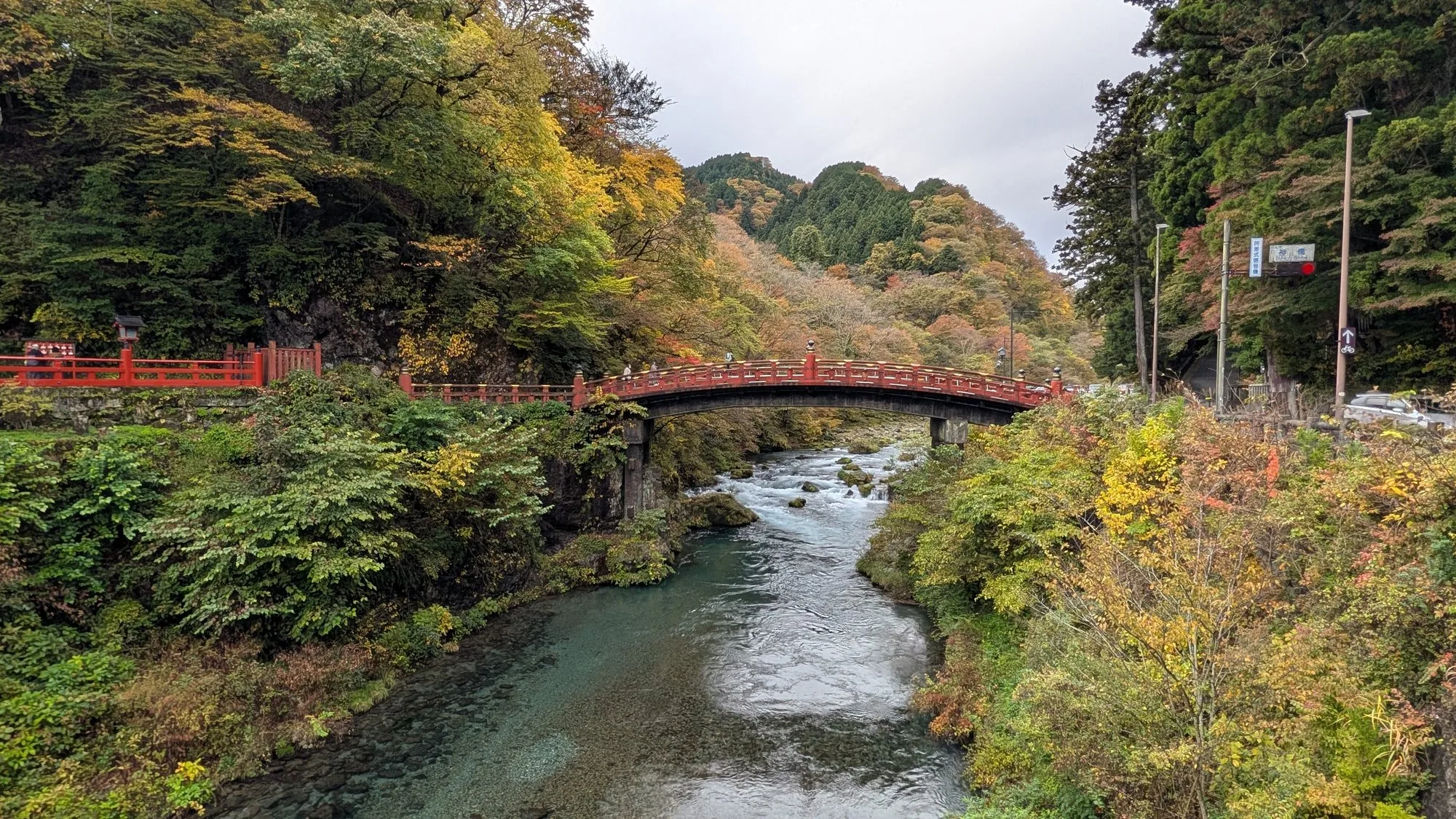
Shinkyo, the red sacred bridge over the Daiya River, belongs to Futarasan and sits at the entrance to the precinct. Official Nikko City tourism lists the fee to walk on the bridge at ¥300 for adults, ¥200 for high school students, and ¥100 for elementary and junior high students. Hours are 8:30 a.m. to 4:30 p.m. from April through October, and 9:30 a.m. to 3:30 p.m. from November through March. You can still see the bridge clearly from the public path if you do not want to pay to cross it.
For Toshogu itself, official Nikko City tourism lists adult and high school admission at ¥1,600, and elementary and junior high admission at ¥550. Hours are 9:00 a.m. to 5:00 p.m. from April through October, with last entry at 4:30 p.m., and 9:00 a.m. to 4:00 p.m. from November through March, with last entry at 3:30 p.m. Details on the carvings and how to buy tickets are in our Toshogu shrine guide.
The red Shinkyo Bridge over the Daiya River at the entrance to Nikko's shrine and temple area
Take a train to Tobu-Nikko Station or JR Nikko Station. From either station, official Nikko City tourism points you to the World Heritage sightseeing bus. The Shinkyo stop is about seven minutes from the stations and a short walk from the bridge. For Rinnoji Temple, stay on toward the stop by the statue of Shodo Shonin (Shodoshoninzo-mae). Our Nikko day trip from Tokyo covers rail choices in more detail. Confirm the day's bus fare and timetable with the operator, because those figures change.
If you would rather skip the train and bus transfers, our Nikko private day tour from Tokyo is a 10-hour private car day. It starts at $550 for two people in a sedan, and you can ask to include Rinnoji Temple when you book.
Keep the order of the day loose. A simple loop is Sanbutsudo first, while it is quieter, then Toshogu after it opens, then Futarasan and Taiyuin, with Shinkyo at the start or the end of the walk. That is a suggestion, not a timed itinerary. If one line is long, swap the order, and leave Taiyuin out if you are short on time rather than rushing the halls you do enter.
If you want a day built around Rinnoji Temple and the rest of the precinct, get in touch or browse our custom tours.
The official Rinnoji information page lists 8:00 a.m. to 5:00 p.m. from April through October, and 8:00 a.m. to 4:00 p.m. from November through March, with last entry 30 minutes before closing. Some halls close or limit entry on ritual days, so confirm your date on that official page.
Official single tickets are ¥400 for adults at Sanbutsudo and ¥550 at Taiyuin, with elementary and junior high tickets at ¥200 and ¥250. A Rinnoji set for both halls is ¥900 for adults and ¥400 for elementary and junior high students, sold only until 2:30 p.m. from April through October and until 1:30 p.m. in the winter season. A full set that also includes the Treasure House is ¥1,000 for adults and ¥500 for elementary and junior high students, sold only at the Sanbutsudo ticket office or as an official e-ticket.
The official Rinnoji information page said the old World Heritage combined ticket (the 社寺共通拝観券) was suspended as of November 16, 2026. Buy the temple's own single or set tickets until that page says the combined ticket is back on sale.
No. Two bows, two claps, and one bow is the usual prayer at Shinto shrines such as Toshogu and Futarasan. Rinnoji Temple is Buddhist, so skip the clapping, enter quietly, and bow if you pause in front of the Buddhas.
From JR Nikko Station or Tobu-Nikko Station, official Nikko City tourism points you to the World Heritage sightseeing bus. Get off at Shodoshoninzo-mae for the temple, or at Shinkyo if you want to start at the sacred bridge. Confirm the day's bus fare and timetable with the operator.
Yes. They sit in the same Sannai precinct, a short walk apart. Rinnoji Temple officially opens at 8:00 a.m., and Toshogu at 9:00 a.m. A loose order is Sanbutsudo first, then Toshogu, then Futarasan and Taiyuin, with Shinkyo at the start or the end. Leave a hall out if you are short on time rather than rushing every ticketed building.
Private tours for this destination
Ready to see it in person? These private tours cover the places in this guide.