Nikko Toshogu Shrine Guide: Tickets, Carvings and Tips
Nikko Toshogu Shrine is the lavish resting place of shogun Tokugawa Ieyasu. Here is what the 1,600 yen ticket covers, the opening hours, the carvings worth finding, and an easy route through the grounds.
Nikko Toshogu Shrine is the mausoleum shrine of Tokugawa Ieyasu, the warlord who founded the shogunate that ruled Japan for about 260 years, and it is the one place in Nikko most visitors would never skip. This guide sticks to Toshogu itself: what your ticket covers, when the gates open, which buildings and carvings to look for, the order to walk them in, and how to get there from Tokyo. Plan on 90 minutes to two hours inside the grounds.
Ieyasu died in 1616 and was first buried at Kunozan in Shizuoka. Following his own wishes, his remains were moved to Nikko a year later, and the shrine was formally dedicated in April 1617. In 1645 the imperial court granted it the title of "gu," and it has been called Toshogu ever since.
Most of what you see today is not that first shrine. In 1636 Ieyasu's grandson Iemitsu, the third shogun, rebuilt the complex on a far grander scale. According to the shrine, the job covered 55 buildings, cost 568,000 ryo of gold, and was finished in only one year and five months. The buildings are lacquered, painted in bright colors and covered in carvings, and the shrine points out that those carvings are not just decoration. They carry religious ideas, scholarship and moral lessons.
Eight of the buildings are National Treasures, and the complex became part of the "Shrines and Temples of Nikko" World Heritage Site in December 1999. A long restoration project has worked through the buildings in recent years, so the colors on the main gate and many carvings now look fresh rather than faded.
Nikko Toshogu Shrine tickets and opening hours
These are the prices and hours on the shrine's official site as of November 2026.
Opening hours
April 1 to October 31: 9:00 a.m. to 5:00 p.m.
November 1 to March 31: 9:00 a.m. to 4:00 p.m.
Ticket sales stop 30 minutes before the gates close in both seasons.
The shrine is open every day, but festivals, ceremonies or repair work can close parts of it, so call or check the official site if your date falls on a festival.
Admission prices
Toshogu entry ticket: 1,600 yen for adults and high school students, 550 yen for elementary and junior high students
Combined ticket with the Toshogu Museum: 2,400 yen for adults, 870 yen for children
Toshogu Museum only: 1,000 yen for adults, 400 yen for children
Toshogu Art Museum: 800 yen for adults, 400 yen for children
The entry ticket covers the area from the Omotemon gate through Yomeimon, the worship hall, the east corridor with the Sleeping Cat, the Okumiya inner shrine where Ieyasu is buried, and Honjido Hall with the Crying Dragon. The museum is a separate building just outside the shrine complex and is not included in the basic ticket.
The Nikko Official Guide notes that the ticket counter takes cash only. You can also buy tickets online through partners such as Tobu Top Tours, Klook or GetYourGuide, but you must swap the voucher for a paper ticket at the Tobu-Nikko Station Tourist Center first. The shrine entrance cannot exchange it for you.
What to see inside the shrine grounds
The buildings run uphill along stone stairways, and the route is easy to follow. Here are the stops worth slowing down for, roughly in the order you reach them.
Stone torii and the five-story pagoda
The stone torii at the bottom of the steps was donated in 1618 by Kuroda Nagamasa, lord of Chikuzen in Kyushu. The stone was shipped from Kyushu and then hauled overland to Nikko by hand. Just to the left stands the five-story pagoda. The first one was donated in 1650 by Sakai Tadakatsu, lord of Obama, but it burned in 1815, and the pagoda you see was rebuilt in 1818 by the same family.
The Sacred Stable and the three monkeys
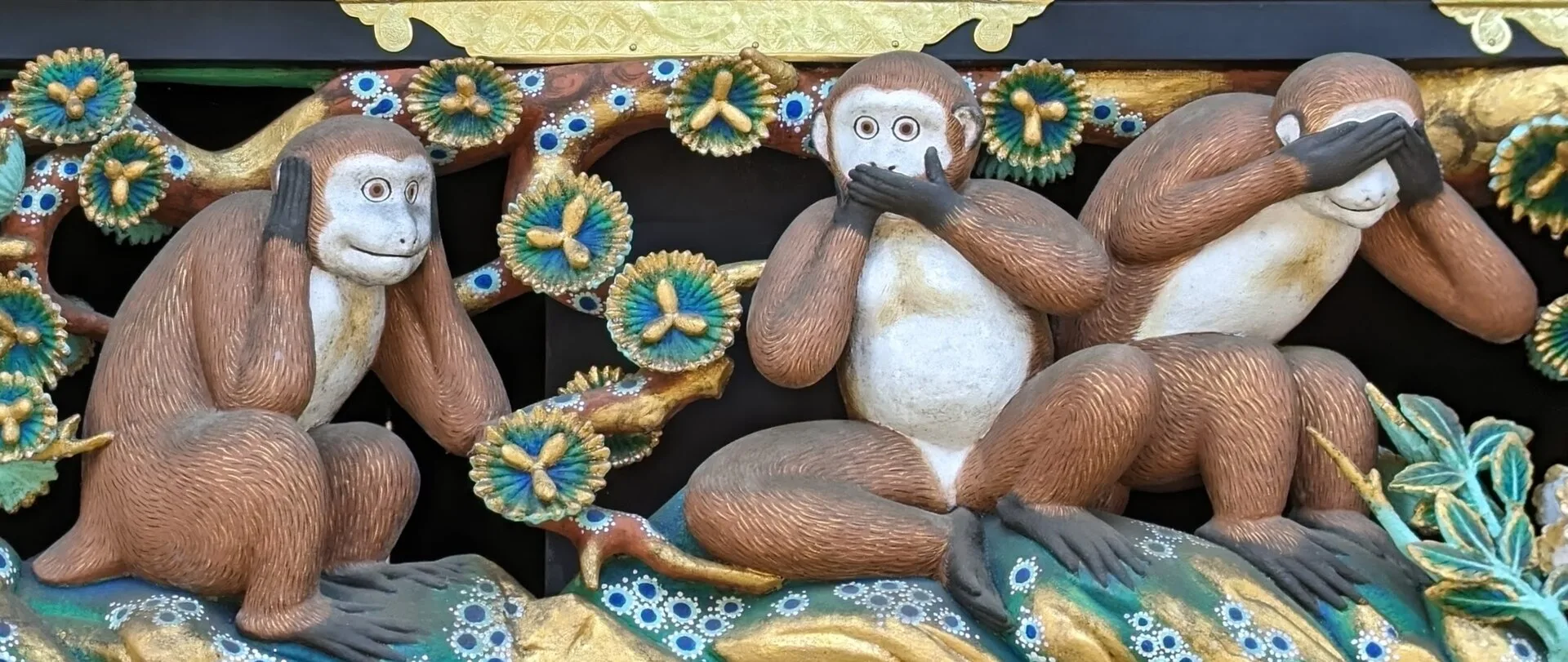
Inside the Omotemon gate, look up at the Shinkyusha, the stable for the shrine's sacred horse. Monkeys were long believed to protect horses, so eight carved panels of monkeys run along the beam. Together they tell the story of a human life, and the most famous panel shows the three monkeys who "see no evil, speak no evil, hear no evil."
Carving of the three wise monkeys covering their ears, mouth and eyes on the Sacred Stable at Nikko Toshogu Shrine
The three wise monkeys on the Sacred Stable at Nikko Toshogu Shrine, shown after restoration. Photo: Jpatokal / Wikimedia Commons (CC BY-SA 4.0).
Before you climb on, check the three storehouses nearby. Under the roof of the upper storehouse is a large carving of two elephants. They look a little odd because the design, sketched by the painter Kano Tanyu, came from imagination rather than from a real elephant, which is why the shrine calls them the "imagined elephants."
The purification fountain
The Omizuya is where you rinse your hands and mouth before you pray. Its stone basin was donated in 1618 by Nabeshima Katsushige, lord of Saga. Take the ladle in your right hand, rinse your left hand, switch and rinse your right, then pour a little water into your cupped left hand to rinse your mouth. Never drink straight from the ladle.
Yomeimon gate
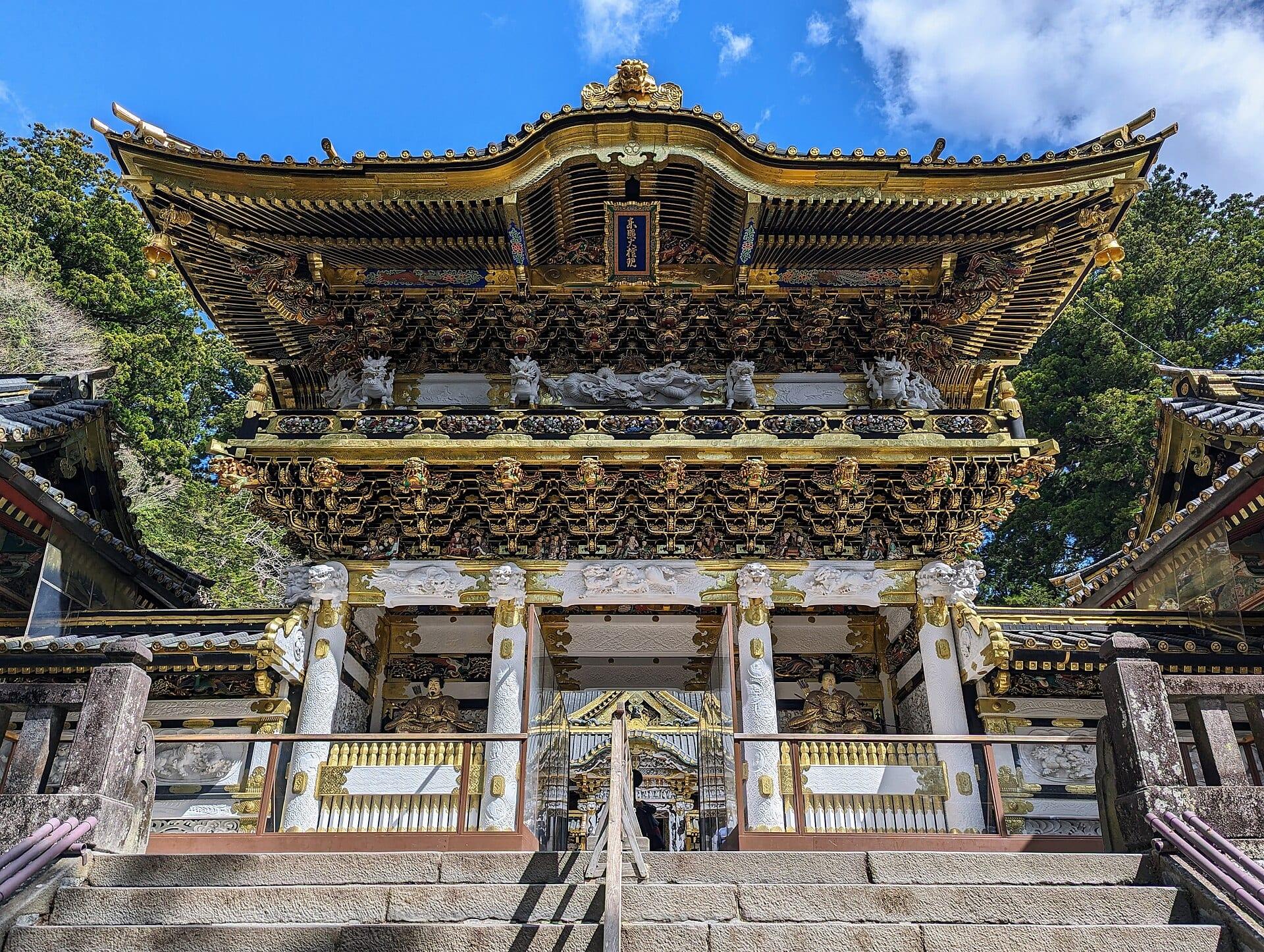
Yomeimon is a National Treasure and the image most people have in mind when they think of Toshogu. The shrine says it carries more than 500 carvings of old legends, children at play, and sages and wise men. Its nickname is Higurashi no Mon, often translated as the "Twilight Gate," because you could stare at it until the sun goes down and still not see everything. Give it a few minutes before you walk through, and look up at the layers of carved figures under the roof.
On each side of the gate runs the corridor, or kairo. Its outer walls hold some of the largest carved and painted panels of flowers and birds in Japan, each cut through a single board of wood.
Karamon and the main sanctuary
Past Yomeimon is Karamon, a small gate painted white with crushed shell and covered with fine carvings of Chinese stories. Behind it is the main sanctuary, made up of the inner hall, the stone room and the worship hall. This is the most important part of the shrine, where its yearly festivals take place. At the worship hall, the usual Shinto way to pray is to drop a coin in the box, bow twice, clap twice, and bow once more.
The Sleeping Cat and the climb to Ieyasu's tomb
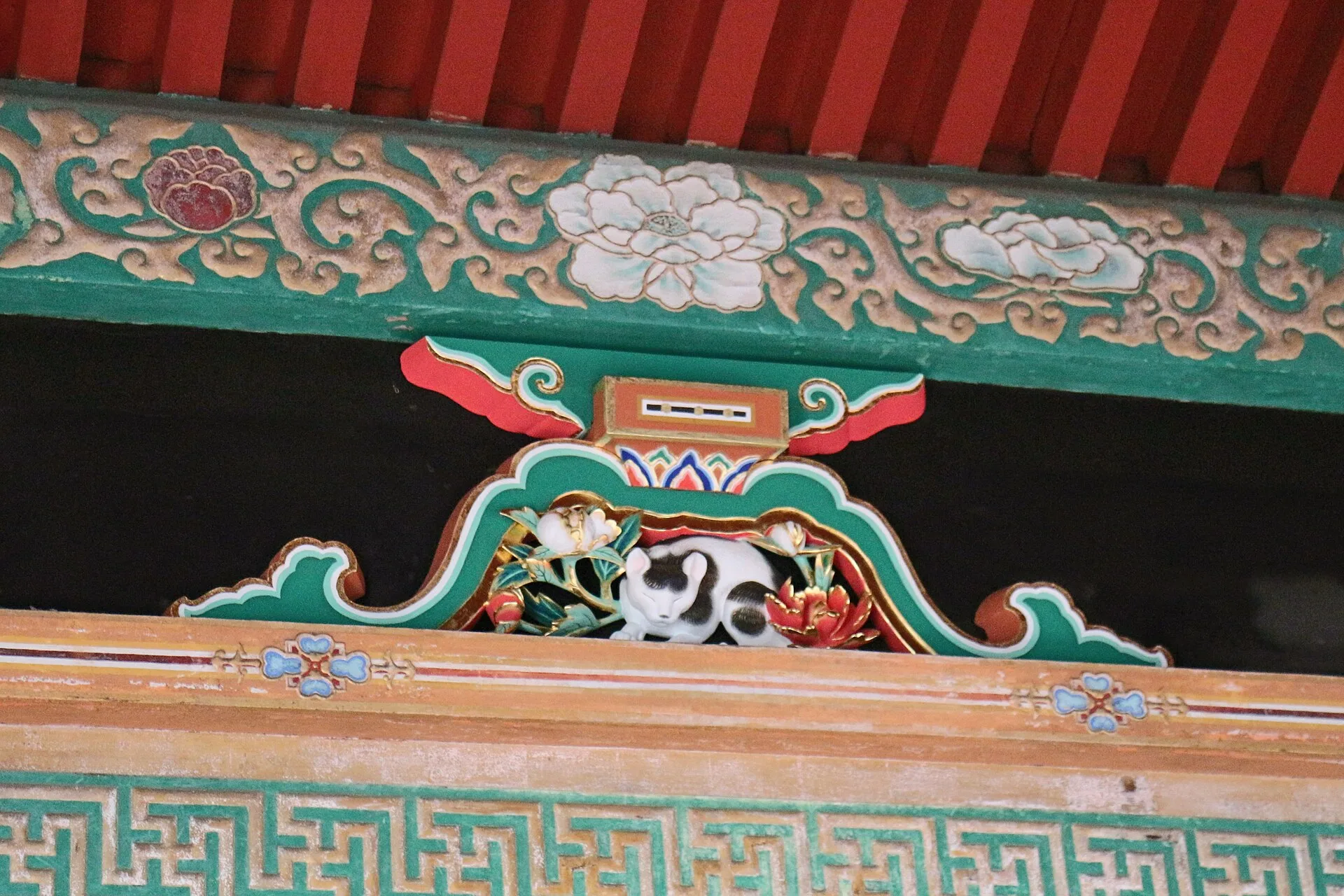
In the east corridor, a small gate leads to the Okumiya. Look up above that gate for the Nemuri-neko, or Sleeping Cat. It is a National Treasure, small enough to walk right past, and tradition credits it to the carver Hidari Jingoro. The shrine notes that the cat is dozing among peonies in the sunlight, and that it may have been carved as a play on the name Nikko, which means "sunlight."
The small Nemuri-neko sleeping cat carving among peonies above a gate at Nikko Toshogu Shrine
The Nemuri-neko, or Sleeping Cat, above the gate to the inner shrine at Nikko Toshogu. Photo: Suicasmo / Wikimedia Commons (CC BY-SA 4.0).
Through that gate, a long stone stairway climbs through tall cedars to the Okumiya. It is made up of a worship hall, a cast metal gate and the treasure tower that marks Ieyasu's grave. The climb is steep and takes several minutes, so take it slowly. It is also much quieter up here than down by Yomeimon.
Honjido Hall and the Crying Dragon
Save Honjido for last. A large dragon is painted on the ceiling, and when a sound is made under its head, the hall answers with a ringing echo that sounds like a dragon's cry. That is how it got the name Nakiryu, the Crying Dragon. The ticket covers this hall, so do not skip it on your way out. Photos are not allowed inside some halls, so follow the signs.
Visiting the Toshogu Museum
The Toshogu Museum, or Homotsukan, sits just outside the main shrine complex. It holds items Ieyasu used, along with offerings from the imperial court, the shoguns and feudal lords, and ritual objects from the shrine. If you are interested in the man behind the shrine, the combined ticket saves you 200 yen compared with buying the two separately. Allow extra time on top of your shrine visit.
The smaller Toshogu Art Museum is separate again. It shows painted cedar doors, sliding doors and hanging scrolls from the old shrine office, about 100 pieces in all.
A simple route and timing tips
The shrine's own audio guide is a good way to make sense of the carvings without a human guide. It covers 29 buildings in Japanese, English or Chinese, costs 500 yen for the day, and is handed out straight ahead after you pass through the Omotemon gate. Rentals run from 9:00 a.m. to 4:00 p.m. from April to October and 9:00 a.m. to 3:00 p.m. from November to March. Individual visitors do not need to book.
Here is an easy plan for a first visit:
Arrive close to 9:00 a.m., when the gates open. Tour groups tend to fill Yomeimon from mid-morning.
See the torii and pagoda, then the Sacred Stable and the purification fountain.
Spend real time at Yomeimon and Karamon, then pray at the worship hall.
Find the Sleeping Cat and climb to the Okumiya.
Come back down and finish at Honjido for the Crying Dragon.
Add the museum if you bought the combined ticket.
Wear comfortable shoes, because there are many stone steps and gravel paths. You will take your shoes off for some halls, so socks you do not mind showing are a good idea. For more on what to wear, see our Japan temple dress code guide, and for bowing and prayer, read our guide to Japanese temple etiquette. Bring cash for the ticket counter and the offering box.
Festivals and the best time to visit
Spring and fall are the most comfortable seasons, and the busiest. If you can match your trip to the grand festival, it is worth it. On May 17 there is yabusame, horseback archery, at 1:00 p.m., and on May 18 the "Procession of 1,000 Samurai" leaves at 11:00 a.m., with more than 1,200 people in armor and costume escorting the shrine's three portable shrines. The fall festival brings yabusame again on October 16 and the procession on October 17. Expect big crowds and possible closures on those days. Winter is quieter, and in snow the colors of the buildings stand out even more.
How to get to Nikko Toshogu Shrine from Tokyo
The shrine's official access page lists these train times:
Asakusa to Tobu-Nikko Station on the Tobu Limited Express Kegon: about 1 hour 50 minutes
Shinjuku to Tobu-Nikko Station on the JR Limited Express Nikko: about 2 hours
Utsunomiya to JR Nikko Station on the JR Nikko Line: about 45 minutes, after a shinkansen from Tokyo
Fares depend on the train and seat type, so check the Tobu or JR site for the current price before you go. From Nikko Station or Tobu-Nikko Station, the World Heritage Tour bus takes about 13 minutes to the Omotesando bus stop, which the Nikko Official Guide lists as the stop for Toshogu. If you drive, the shrine's large parking lot charges 600 yen a day for a regular car.
Toshogu shares the hillside with Rinnoji Temple and Futarasan Shrine, both part of the same World Heritage Site, and you can walk between all three. Down at the Daiya River, the red Shinkyo Bridge sits near the start of the shrine area. Many travelers stop for yuba, the tofu skin Nikko is known for, before heading higher up to Lake Chuzenji and Kegon Falls. Our Nikko private tour guide covers the lake, the falls and the mountain side of the trip.
See Nikko Toshogu Shrine with a private guide
The carvings at Toshogu make a lot more sense when someone explains the stories behind them, and the trains and buses are easier with a driver. Our Nikko private day tour from Tokyo takes you from your hotel to the shrine and the sights around it at your own pace. If you want more time, the Tokyo, Fuji and Nikko 3-day tour adds Mount Fuji to the trip. Contact us and we will help you plan your day.
Featured photo: Yomeimon gate at Nikko Toshogu Shrine after its restoration. Photo: Jpatokal / Wikimedia Commons (CC BY-SA 4.0).
TopicsNikkoNikko Toshogu ShrineShrinesWorld HeritageDay Trips from Tokyo
Frequently Asked Questions
The Toshogu entry ticket costs 1,600 yen for adults and high school students and 550 yen for elementary and junior high students. A combined ticket with the Toshogu Museum is 2,400 yen for adults. The ticket counter takes cash only.
The shrine is open from 9:00 a.m. to 5:00 p.m. from April to October and from 9:00 a.m. to 4:00 p.m. from November to March. Ticket sales end 30 minutes before closing, and festivals or repair work can close some areas.
Plan on 90 minutes to two hours for the shrine grounds, including the climb to Ieyasu's tomb and Honjido Hall. Add extra time if you also visit the Toshogu Museum.
No. The museum is a separate building just outside the shrine complex. It costs 1,000 yen on its own, or you can buy the 2,400 yen combined ticket, which saves 200 yen.
The three monkeys are carved on the Sacred Stable, just inside the Omotemon gate. The Sleeping Cat is above a small gate in the east corridor that leads to the Okumiya, the inner shrine where Ieyasu is buried. Both are covered by the standard ticket.
Take the Tobu Limited Express from Asakusa to Tobu-Nikko Station, about 1 hour 50 minutes, or the JR Limited Express Nikko from Shinjuku, about 2 hours. From the station, the World Heritage Tour bus takes about 13 minutes to the Omotesando stop near the shrine.
Private tours for this destination
Ready to see it in person? These private tours cover the places in this guide.