Omikuji in Japan: How to Draw and Read a Fortune Slip
Omikuji are fortune slips drawn at Japanese shrines and temples. This guide covers official fees, how to draw and read the ranks, and what to do with the slip afterward.
Omikuji are the paper fortune slips you can draw at many Shinto shrines and Buddhist temples in Japan. The slip usually gives an overall luck rank, then short lines on topics such as health, work, love, study, and travel. The details change from place to place, so treat what follows as a general guide, not a single national rulebook.
I checked official pages from the Japan National Tourism Organization (JNTO), the Association of Shinto Shrines (Jinja Honcho), and Meiji Jingu on November 17, 2026. Fees and methods are set by each shrine or temple, so follow the posted instructions on site.
This article stays with the fortune slip itself. For bowing, hand washing, and how to behave in the precinct, see our guides to Japanese temple etiquette and Japanese etiquette.
What omikuji is
JNTO describes omikuji as a practice with nearly 1,000 years of history. It is said to have started when people drew lots to hear a divine opinion on matters such as government outcomes or the choice of a successor, and later became a way for individuals to read their own fortune. The official Jinja Honcho page on omikuji makes a similar point: older forms of divination asked for the will of the kami, and the personal fortune-slip form familiar today is described as appearing in the Edo period.
A typical slip has two parts. One is an overall rank, such as excellent luck or bad luck. The other is advice on everyday subjects. Jinja Honcho lists examples such as money luck, love, lost items, travel, people you are waiting for, and health. Some slips also carry a waka poem meant as guidance, rather than a simple luck grade. The same official page says the most important step is to read the wording carefully and use it as a guide for how you live, not only to react to the rank at the top.
You will find omikuji at both shrines and temples. The method is often similar, even if the beliefs behind the site are not.
Older slips, JNTO notes, often carried a Chinese or classical Japanese poem with an explanation in modern Japanese. Many sites now also print the fortune in other languages, because so many visitors come from outside Japan. That change is helpful, but it does not mean every stand has an English version.
How to draw omikuji
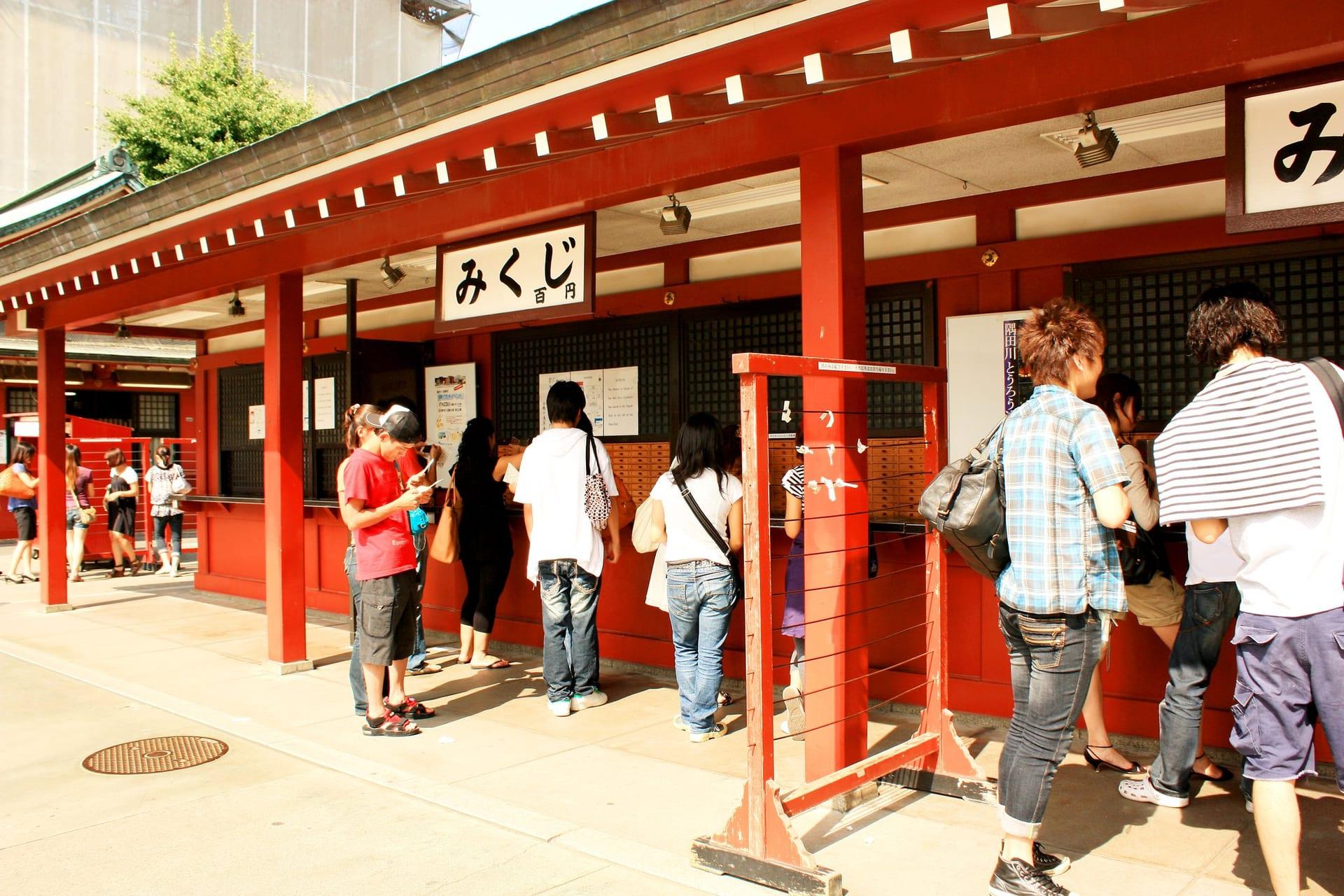
JNTO says the fee varies by shrine and temple, but is usually about ¥100 to ¥200. Confirm the posted amount before you pay. At Senso-ji in Tokyo, the stand itself is often marked as ¥100, which fits that usual range.
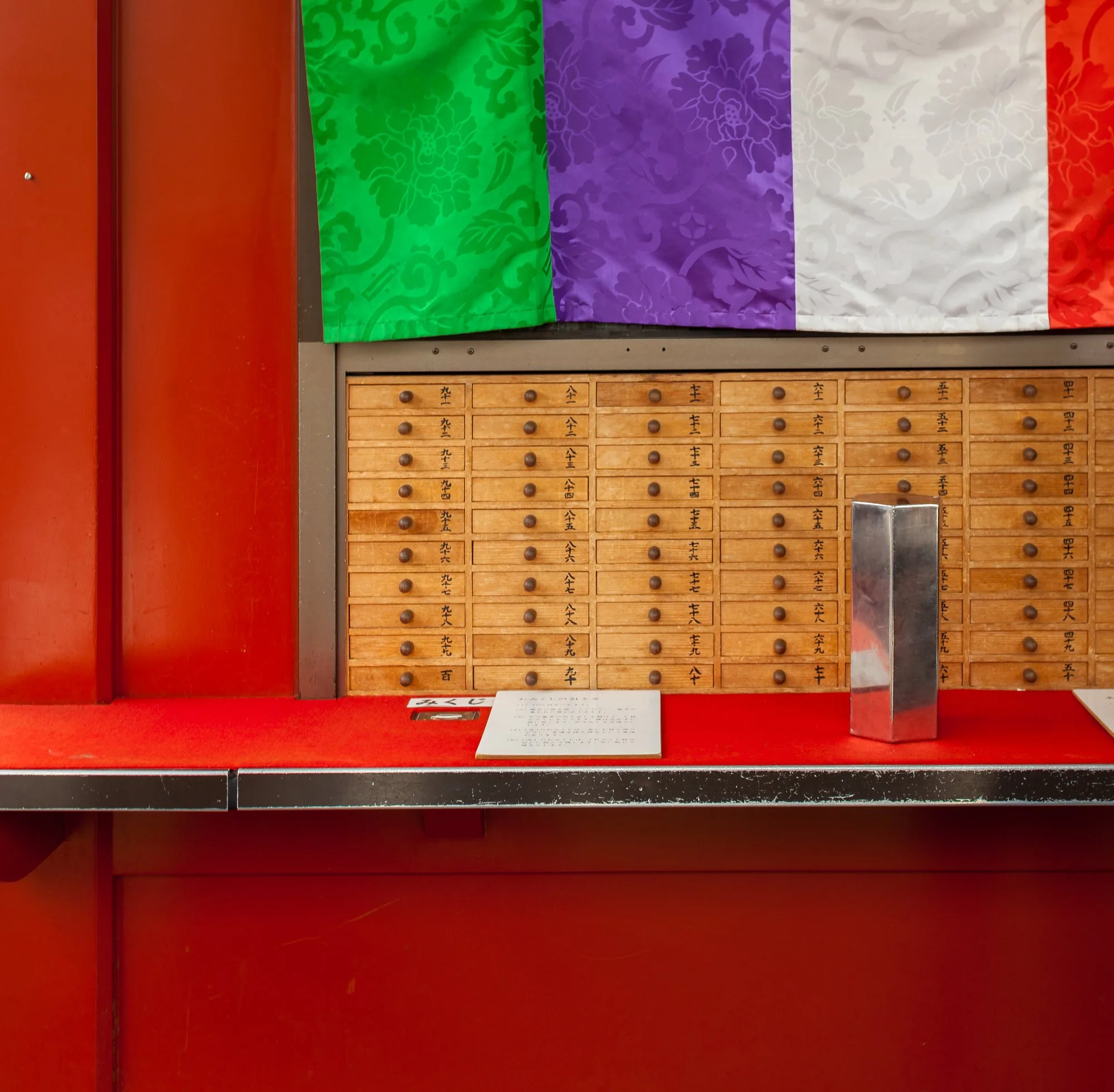
The usual method, again from JNTO, is a square or cylinder box filled with long, thin sticks called mikuji-bo. You shake the box until one stick comes out of the small opening. The number on the stick matches a drawer or a pile of slips. Take the matching paper, then put the stick back if a sign asks you to. If the system is not obvious, ask at the counter. Some places use a staffed window. Others use a machine. JNTO mentions unusual setups as well, including the mechanized "Karakuri Omikuji" at Nishiki Tenmangu in Kyoto, where a lion automaton brings the slip after you put money in.
A simple order that works at most sites:
Finish your visit to the hall first, if that is the local custom, then go to the omikuji stand.
Pay the posted fee.
Shake the box, or follow the machine or staff instructions.
Take only the slip that matches your number.
Step aside to read it, so you are not blocking the next person.
Do not draw again and again at the same stand in hopes of a better rank. One slip is the usual practice. If a sign says something different, follow the sign.
Have coins ready in the usual ¥100 to ¥200 range, because some stands are self-service and may not make change. If you shake the box and two sticks start to come out, stop and reset rather than choosing the number you like better. The point of the box is that you accept the slip you are given.
A numbered wooden omikuji cabinet and metal shake box at Senso-ji in Tokyo
Start with the large characters at the top, then read the smaller lines underneath. JNTO lists a common order, from best to worst: dai-kichi (excellent luck), kichi (general luck), chu-kichi (middle luck), sho-kichi (small luck), and kyo (bad luck). Jinja Honcho notes that the ranks and their order vary by shrine, and gives an example that also includes suekichi, often translated as luck that comes later: dai-kichi, kichi, chu-kichi, sho-kichi, suekichi, and kyo. Other sites use still more grades, or fewer.
That variation matters. A rank that sits in one place on one shrine's list may sit in another place somewhere else. Do not assume a single official ladder for the whole country. Read the explanation on your own slip, including any advice that comes after a poorer rank. JNTO says that even a bad-luck result usually explains how to improve your fortune, so read it through instead of stopping at the heading.
Not every site uses ranks at all. Official Meiji Jingu pages describe their omikuji as oracles in the form of traditional waka poems, not as a luck scale. Thirty poems by Emperor Meiji and Empress Shoken have been chosen, with English translations, and the official offering is ¥100. The shrine presents the poem as a message to sit with, not as a grade of excellent or bad luck.
English slips are more common than they used to be, but they are not universal. If your slip is only in Japanese, the staff can sometimes help, or you can photograph the text and translate it later. Take your time. The paper is small, and the advice is the part worth keeping.
What to do with your slip
Practice is not identical at every site, and official sources do not always agree on a single rule. JNTO describes a general tradition: take a good result home so the luck stays with you, and if you draw bad luck, tie the paper at a designated place on the grounds. The Association of Shinto Shrines is more flexible. Its official omikuji page says there is a custom of tying the slip at the shrine's tying place before you leave, and also that taking it home is fine. In both cases, the association's emphasis is on rereading the words and applying them, not on disposing of the paper as a magic fix.
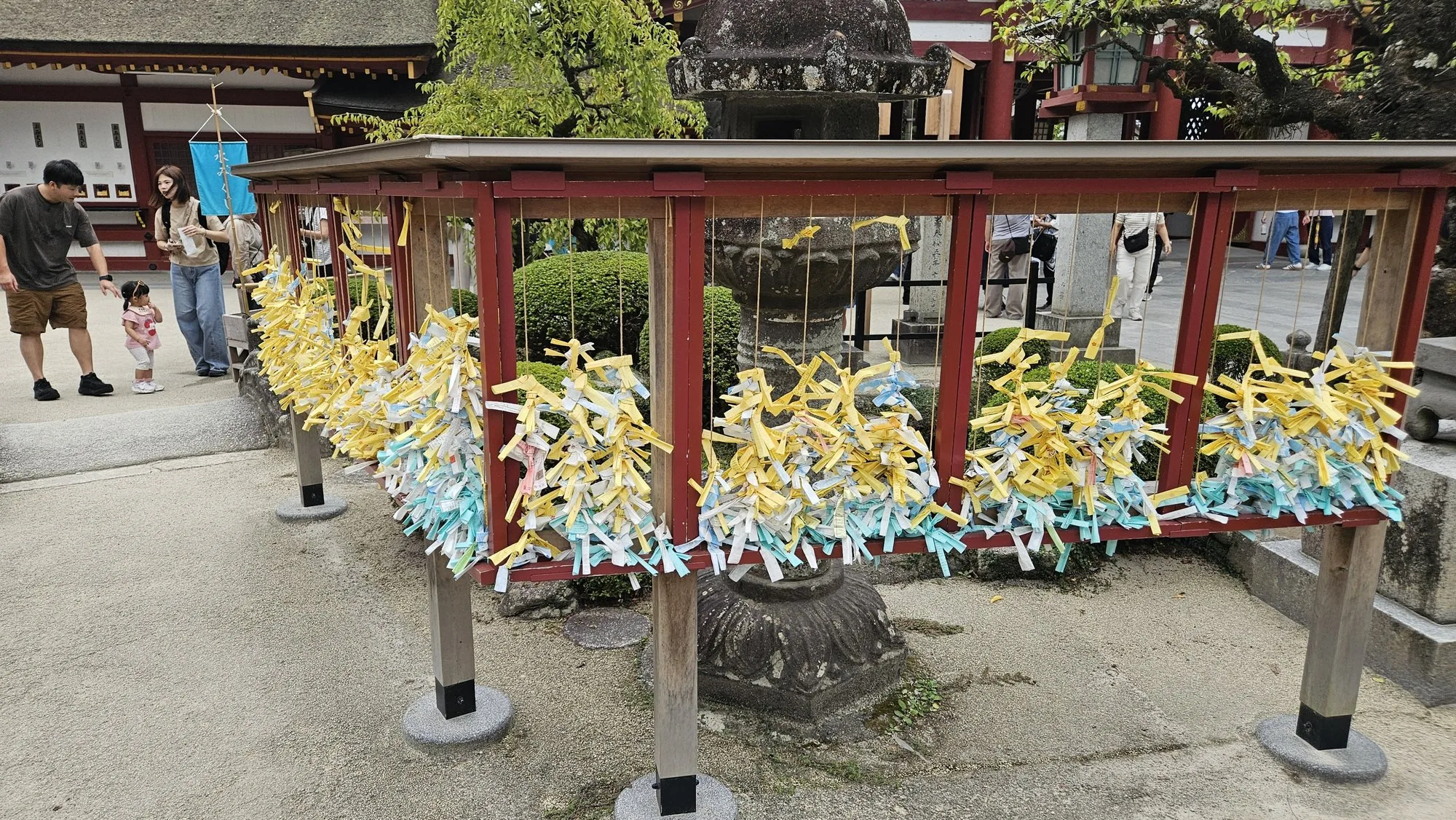
Look for a marked rack, strings, or a tying area near the stand or along the path. JNTO mentions strings set up for this purpose. Use those, and do not tie a slip to an unmarked tree or a railing that is not meant for it.
If you keep the slip, fold it and put it in a wallet, a notebook, or your bag. There is no official requirement to frame it, and there is no official ban on keeping a poorer result if you want the reminder. If you are unsure, ask. Local staff will point you to the tying place, or tell you that this shrine prefers you to take the paper with you.
Colored omikuji fortune slips tied to a designated wooden rack at Dazaifu Tenmangu
Omikuji tied to a designated rack at Dazaifu Tenmangu, the kind of marked place to use if you leave a slip behind. Photo:Aspere / Wikimedia Commons,CC BY-SA 4.0.
Where to find English omikuji
You can draw omikuji at shrines and temples all over Japan, including small neighborhood sites. If you want a slip in English, JNTO specifically lists Senso-ji in Tokyo; Narita-san Shinsho-ji in Chiba, which also has Chinese and Korean; Tsurugaoka Hachimangu in Kamakura; and Nishiki Tenmangu in Kyoto. Meiji Jingu, as noted above, provides English translations of its waka oracles.
Those are useful starting points, not a ranked list of the best places. A quiet local shrine can be just as meaningful, even if the slip is only in Japanese.
Senso-ji sits in Asakusa and is an easy first stop if you are already in Tokyo. Meiji Jingu is a short walk into the woods from Harajuku or Meiji-jingumae, and its poem-style oracles are a good contrast if you have already drawn a ranked slip somewhere else. Tsurugaoka Hachimangu is in Kamakura, and Nishiki Tenmangu is in central Kyoto, near Nishiki Market. None of these require a timed itinerary. Draw a slip as part of a regular visit, then keep walking.
New Year, when many people make their first shrine visit of the year, is the busiest time, and lines at the popular stands can be long. Omikuji are available through the rest of the year as well, whenever the stand is open. If a festival is underway, the same advice holds: follow the signs, pay the posted fee, and do not block the path.
If you want a private day that includes Tokyo shrines and temples, our Tokyo Temples and Japanese Gardens Private Day Tour starts at $450 for two people in a sedan. You can ask to include time for omikuji when you book.
Draw one slip, read all of it, and then decide, based on the signs in front of you, whether to keep it or tie it at the marked place. If you want help planning a shrine-and-temple day around this, get in touch or browse our custom tours.
TopicsomikujiJapanese culturefortune tellingtravel in Japanshrine etiquette
Frequently Asked Questions
JNTO says the fee varies by shrine and temple, but is usually about ¥100 to ¥200. Confirm the posted amount. At Meiji Jingu, the official offering for a waka oracle is ¥100. Some stands are self-service, so it helps to have coins ready.
Pay the posted fee, then shake the square or cylinder box of numbered sticks, called mikuji-bo, until one stick comes out. The number on the stick matches a drawer or a pile of slips. Take that slip and return the stick if a sign asks you to. Some sites use a staffed window or a machine instead. Follow the local instructions if the method is not obvious.
Ranks and their order vary by shrine and temple. JNTO lists a common order from best to worst: dai-kichi (excellent luck), kichi (general luck), chu-kichi (middle luck), sho-kichi (small luck), and kyo (bad luck). Jinja Honcho gives an example that also includes suekichi. Read the explanation on your own slip, not only the heading. Meiji Jingu's official oracles are waka poems with English translations, not a luck scale.
JNTO describes a general tradition of taking a good result home and tying a bad-luck slip at a designated place on the grounds. The Association of Shinto Shrines says tying at the shrine's tying place is a custom, and that taking the slip home is also fine. Use a marked rack or strings, not an unmarked tree. If you are unsure, ask the staff.
JNTO lists English omikuji at Senso-ji in Tokyo, Narita-san Shinsho-ji in Chiba (also Chinese and Korean), Tsurugaoka Hachimangu in Kamakura, and Nishiki Tenmangu in Kyoto. Meiji Jingu provides English translations of its waka oracles. Many other sites still offer Japanese-only slips.
Omikuji are available year-round at many shrines and temples, whenever the stand is open. New Year, when many people make their first shrine visit of the year, is the busiest time. You do not need to wait for a festival or a special date.